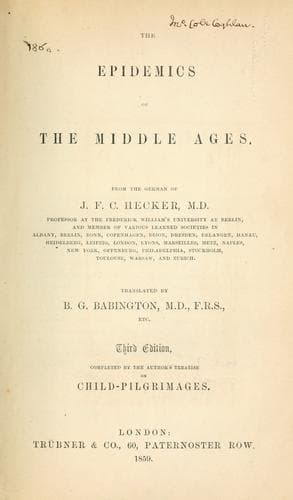
The Epidemics of the Middle AgesHecker, J. F. C. (Justus Friedrich Carl)
History
The Epidemics of the Middle Ages
Hecker, J. F. C. (Justus Friedrich Carl)
Black Death; Epidemics -- History; Hysteria, Epidemic
Phenomena of an opposite character, on the contrary, afforded
hope of recovery.
The best physicians were agreed on the importance of the petechiæ as an
indication of the nature of the crisis; for those cases in which they
were abundant and of a good quality were cured much more easily than
those in which the eruption was suppressed. An abundant perspiration
also was particularly conducive to recovery, whereas all other
evacuations, especially a flux from the bowels, proved to be injurious
and even fatal.
If we keep these phenomena in view, and consider, moreover, that in
the widely extending lues venerea of those times cutaneous eruptions
predominated over the other symptoms, the English sweating sickness
in the north of Europe will appear, as in connexion with this
circumstance, of a very important character; and the supposition,
that the morbid activity of the system during the whole of this age,
maintained a decided determination to the skin, may thence be fairly
considered as something more than a mere conjecture.
This fact speaks for itself, but the causes of this altered temperament
of the body it is not an easy matter to discover. Fracastoro, who knew
much better than his modern followers how to manage his sagacious
doctrine of contagion, looked for these causes in the quality of the
air, which was manifest by much more evident phenomena in the epidemic
petechial fever of 1528 than in that of 1505, and he traced an active
connexion between this quality, which he called “infection of the
atmosphere,”[420] and the condition of the blood; thus indicating
unknown influences by an obscure notion. He considered the altered
quality of the blood according to the established views of that period,
which the petechial spotted fever seemed clearly to confirm, as a
putrefaction; and he even assumed that, in the non-epidemic petechial
fevers, which, from the year 1505 forward, frequently occurred,
isolated causes must have given rise to changes in the blood, as well
as that quality of the air, to which this great physician attributed
the general and continued alterations which take place in the nature of
diseases.
The petechial fever made the same impression on the physicians of Italy
as new disorders have ever made; for although they were the best in
Europe, their view was bounded by the horizon of Galen, within the
limits of which the novel phenomenon was not to be found. They were
therefore soon perplexed, and whilst they sought to entrammel the
dreaded enemy with scholastic doctrines of repletion and acrimony and
occult qualities, and betook themselves first to one remedy and then
to another, they exposed themselves to the derision of the people,
who soon perceived their disagreement and indecision, and, as usual,
charged on the whole medical profession the well merited blame of
individuals[421].
SECT. 6.—OTHER DISEASES.
Public-domain text, read in full here on John Shaqi.
Reviews
Reviews
No reviews yet
Be the first to share your thoughts on this work.
Elsewhere in the archive
Join the Discussion
Join the discussion
Sign in to leave a comment or review.
Sign InorCreate an account