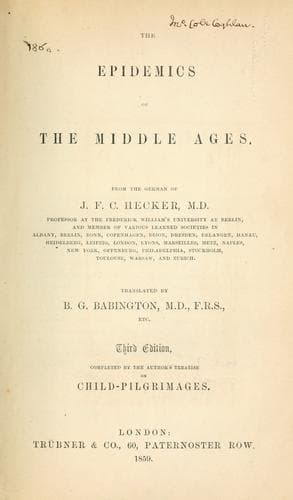
The Epidemics of the Middle AgesHecker, J. F. C. (Justus Friedrich Carl)
History
The Epidemics of the Middle Ages
Hecker, J. F. C. (Justus Friedrich Carl)
Black Death; Epidemics -- History; Hysteria, Epidemic
and black, and arose, often in a very short time on the roofs of
houses, on clothes, on the veils and neck handkerchiefs of women, on
various household utensils, on the meat in larders, &c. A historian,
who speaks also of blood-rain[434], recounts that they could not be
got rid of in less than ten or twelve days, and that they frequently
occurred in closed chests, on linen and on articles of clothing[435].
Much information is not to be expected from the researches of the
naturalists of those times, but there is no doubt that what is
described was some one or more kinds of mould[436], inasmuch as the
whole phenomenon evidently corresponds with modern observations[437].
Scientific physicians of the sixteenth century, among whom the
naturalist George Agricola, who was born in 1494, and died in 1555,
ought especially to be mentioned, recognised, even then, these spots
as lichens, and without seeking to account for them by supernatural
agencies, or lending credence to popular superstition, they gave them
their just interpretation as indications of extensive disease[438].
Should the too bold notion of Nees v. Esenbeck, that fungi of the most
minute forms have their origin in the higher regions of the firmament,
and descending to the surface of the earth, produce spots and stains,
be confirmed, which is not yet the case, these “signacula” would have
a much more important connexion with epidemics than can be otherwise
conceded to them; for though it be highly probable that they have
their origin only in the dissemination of germs in the lower strata
of the atmosphere, it must yet be granted, that if they appear over
a considerable space, and during a long time, as at the commencement
of the sixteenth century, the causes favouring their generation and
spread, must be ranked among those of an extraordinary kind, and on
this very account may exercise an influence over human organism, as was
then evident.
Public-domain text, read in full here on John Shaqi.
Reviews
Reviews
No reviews yet
Be the first to share your thoughts on this work.
Elsewhere in the archive
Join the Discussion
Join the discussion
Sign in to leave a comment or review.
Sign InorCreate an account