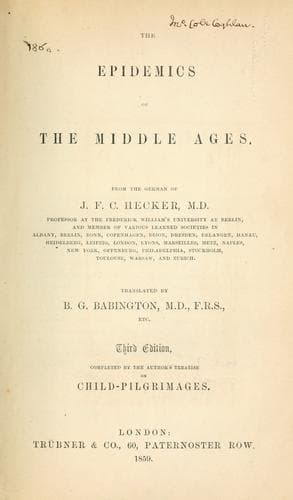
The Epidemics of the Middle AgesHecker, J. F. C. (Justus Friedrich Carl)
History
The Epidemics of the Middle Ages
Hecker, J. F. C. (Justus Friedrich Carl)
Black Death; Epidemics -- History; Hysteria, Epidemic
For so early as the fruitful year 1503, the plague, which had already
appeared partially, made great advances, and France in particular
was visited by so fatal a pestilence, that the inhabitants of towns
and villages, in order to escape the infection, fled in bodies
to the woods, and even the house-dogs became wild, which never
happens, unless a country be extensively depopulated[439]. They were
obliged to establish great hunts, in order to free the country from
these new beasts of prey, and from wolves which appeared in great
multitudes[440]. The dry and continued heat of the following year,
1504, having given rise to still more extensive sickness, and caused
a failure in the crops, the bubo plague raged in Germany with such
violence, that in some places a third part, and in others as many as
half the inhabitants perished. Various kinds of fevers accompanied
this overwhelming disease, among which there was one distinguished
by headache and phrensy similar to that which appeared in France, in
1482[441]. Various putrid fevers and putrid inflammations of the lungs
with bloody expectoration, are also no less plainly discernible from
the accounts[442]. This diversified and general sickness throughout
the whole of Germany, terminated in the cold winter of 1504–5 and the
following summer, during which there was a continued murrain among
cattle. It is certain, that at that time the petechial fever in Italy,
had not yet passed the Alps.
_From all these facts it is a probable conjecture, that the Sweating
Sickness which visited England in the year 1506, although accompanied
in that country itself by no prominent circumstances, was not without
connexion with the morbid commotion of human and animal life in the
south and middle of Europe, and may perhaps be regarded as having
been the last feeble effort of mysterious agencies in the domain of
organized being._
CHAPTER III.
THE THIRD VISITATION OF THE DISEASE.—1517
“This learned Lord, this Lord of wit and art,
This metaphysick Lord, holds forth a Glasse,
Through which we may behold in every part
This boisterous prince.”—HOWELL[443].
SECT. 1.—POVERTY.
Public-domain text, read in full here on John Shaqi.
Reviews
Reviews
No reviews yet
Be the first to share your thoughts on this work.
Elsewhere in the archive
Join the Discussion
Join the discussion
Sign in to leave a comment or review.
Sign InorCreate an account