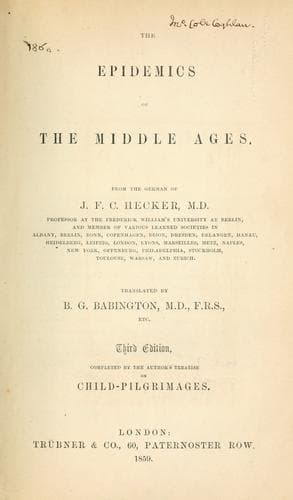
The Epidemics of the Middle AgesHecker, J. F. C. (Justus Friedrich Carl)
History
The Epidemics of the Middle Ages
Hecker, J. F. C. (Justus Friedrich Carl)
Black Death; Epidemics -- History; Hysteria, Epidemic
ammonia in various states of combination,) and their superabundant
acid, the ferment of the disease; and this penetrated into the
lungs of the bystanders as they breathed, and provided they were but
predisposed for its reception, as above stated, continually produced
it. It may be considered as certain that mere manual contact was not
sufficient to communicate the infection, and that this was propagated,
either by the pestilential atmosphere which surrounded the beds of the
sick, or by exhalations generated in unclean situations where there was
no vent for their escape. On this account it was that the residence at
common inns and public-houses was looked upon as dangerous[471].
I would not, however, be understood to maintain that, during the
three epidemics with which, up to the present stage of our inquiry,
we have become acquainted, the spread of the sweating fever alone
was occasioned by infection; for if the general epidemic causes
were powerful enough to excite the disease, without any previously
existing poison, why might they not produce the same effect still more
independently throughout the course of the pestilence, since, as is
the case in all epidemics, those causes in all probability continued
to increase in intensity? That the plague grew worse on the occasion
of any great assemblages of the people, was at that time known, and
the notion of contagion thence very naturally arose. Yet, must it
here be taken into account, that even without this notion, and merely
from the assemblage itself of many people in whom the like malady
was germinating, and already had shewn tokens of its approach, that
approach might easily be accelerated, and the disease increased among
those merely slightly indisposed, by the reciprocal communication of
morbid exhalations. For as the predisposition to any malady, which
is an intermediate condition between that malady and the previous
state of good health[472], plainly displays the properties of the
disease in those whom it _threatens_ to attack, so these exhalations
(or epidemic causes which give rise to Sweating Sickness in the first
instance) certainly differ from those which occur in a sweating
sickness which has already broken out, only in unessential respects,
and might consequently stimulate the mere disposition to the disease
more and more, even to the actual eruption of the disease itself.
Yet a contagion was likewise in operation at the same time which was
destructive even to the temperate, and to those who were apparently
in health, nay, even to foreigners, who were living in an English
atmosphere and on English food, as the example of the Italian Ammonius
plainly proves[473].
Public-domain text, read in full here on John Shaqi.
Reviews
Reviews
No reviews yet
Be the first to share your thoughts on this work.
Elsewhere in the archive
Join the Discussion
Join the discussion
Sign in to leave a comment or review.
Sign InorCreate an account