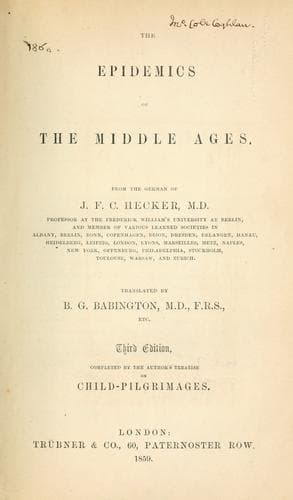
The Epidemics of the Middle AgesHecker, J. F. C. (Justus Friedrich Carl)
History
The Epidemics of the Middle Ages
Hecker, J. F. C. (Justus Friedrich Carl)
Black Death; Epidemics -- History; Hysteria, Epidemic
are these “Ansteckungen!”, from the purely mental, on the one hand,
which, through the mere sight of a disagreeable nervous malady—through
an excitement of the senses that shakes the mind, penetrates into the
nerves, those channels of its will and of its feelings, and produces
the same disorder in the beholder, to those, on the other hand, which
propagate diseases that principally operate only upon matter, and are
distinguishable but little, if at all, from animal poisons. The reader
must not here expect all the features of a doctrine which extends
through the whole immeasurable domain of life. They are clearly
derived from the confirmed and well applied experience of _the past_,
and have been delineated by men[470] who had not forgotten, like their
modern successors, to take a comprehensive view of epidemic diseases.
It may, however, be permitted me just to call to mind the difference
between those infectious diseases which are _permanent_ and for
centuries together _unchangeable_, and those which are _temporary_ and
_transient_. The infecting matter of the former may aptly be called
the perfect or unchangeable in contradistinction to the imperfect or
mutable character of the latter. The former, when once formed, whether
in diseased persons or inanimate substances (fomites), are always
in existence, and are but called into activity by those causes of
general disease (epidemic constitutions) which are favourable to their
propagation; and it is to be remarked that under all circumstances, and
at all times, they excite the same unchangeable diseases, and, varying
only in particular ramifications or degenerations and mild forms, never
lose their proper essence. Examples are furnished in the small-pox, the
plague, the measles, and, if we may include diseases not febrile, the
leprosy, the itch, and the venereal disease. The latter, on the other
hand, are not always in existence, they are called forth from nonentity
by the causes of general diseases or epidemic constitutions, and they
disappear again after the extinction of the epidemic diseases by which
they were bred; they likewise vary in their development and their
course in each particular epidemic. Examples are found in the yellow
fever, in catarrh or influenza, in nervous and putrid fever, and, among
many other disorders, in miliary fever, a disease which first grew
to a national pestilence in the 17th century, and which, in the kind
and manner of its infecting power, approaches nearest to the sweating
fever. To this latter category the English Sweating Sickness likewise
belongs; a disease altogether of a temporary character, which, after
its cessation, left no infecting material behind, and consequently was
incapable of propagating itself after the manner of those diseases
which are completely contagious. The animal matters, which were
expelled along with the profuse perspiration, and spread so horrible a
stench around the sick, contained amid their alkaline salts, (probably
Public-domain text, read in full here on John Shaqi.
Reviews
Reviews
No reviews yet
Be the first to share your thoughts on this work.
Elsewhere in the archive
Join the Discussion
Join the discussion
Sign in to leave a comment or review.
Sign InorCreate an account