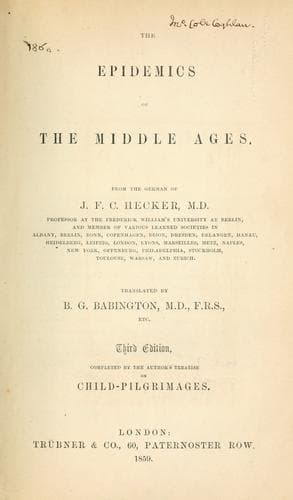
The Epidemics of the Middle AgesHecker, J. F. C. (Justus Friedrich Carl)
History
The Epidemics of the Middle Ages
Hecker, J. F. C. (Justus Friedrich Carl)
Black Death; Epidemics -- History; Hysteria, Epidemic
the rich many died, and some quite suddenly, of this strange disease,
in the treatment of which the physicians shortened life not a little by
their purgative treatment and phlebotomy, seeking an excuse for their
ignorance in the influence of the constellations, and alleging that
astral diseases were beyond the reach of human art[474].
From this prejudicial effect of our chief antiphlogistic remedy,
bleeding, as well as of evacuations from the bowels, we may conclude
that the disease, though in its commencement rheumatic, yet had an
essential tendency to produce relaxation and debility of the nerves,
and in this respect, as well as in its extension to all classes,
accorded with the modern influenzas, in which the same phenomena have
manifested themselves only much less vividly and plainly. The French,
who, from the levity of their character, have always called serious
things by jocose names, designate this disease “Coqueluche” (the monk’s
hood), because, owing to the extreme sensibility of the skin to cold
and currents of air, this kind of hood was generally necessary, and
was a protection against an attack of the malady, as well as against
its increase. That in the accounts, which are, to be sure, very
incomplete, there should be no express mention of any affection of the
air-passages, is remarkable, since this could not in all likelihood
have failed to exist; although it might perhaps have been only slightly
manifested. Nearly a century before (1414), this affection appeared
far more prominently on the occurrence of a no less general disorder
of the same kind; so that all those who had the complaint, suffered
from a considerable hoarseness, and all public business in Paris
was interrupted on this account[475]. It was on that very occasion
that the name Coqueluche was first employed, and this having, as is
well known, been transferred to the whooping-cough, it is easier to
suppose, with respect to the influenza of 1510, which was similarly
named, an omission in the account, than the real absence of a symptom
so very generally prevalent; for in these kinds of comparisons and
denominations, the common sense of the people errs much less than the
learned profundity of political historians.
Public-domain text, read in full here on John Shaqi.
Reviews
Reviews
No reviews yet
Be the first to share your thoughts on this work.
Elsewhere in the archive
Join the Discussion
Join the discussion
Sign in to leave a comment or review.
Sign InorCreate an account