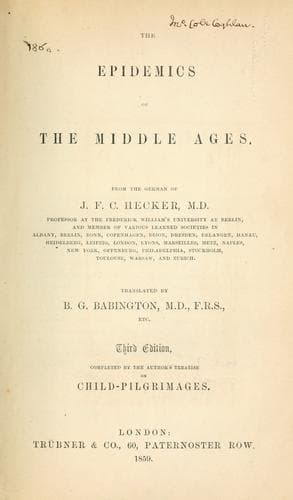
The Epidemics of the Middle AgesHecker, J. F. C. (Justus Friedrich Carl)
History
The Epidemics of the Middle Ages
Hecker, J. F. C. (Justus Friedrich Carl)
Black Death; Epidemics -- History; Hysteria, Epidemic
We must not omit here to remark that three years before (1411), and
thirteen years afterwards, two diseases entirely similar and equally
general, made their appearance in France, of which we nowhere find that
any notice has been taken up to the present time. The first was called
_Tac_, the second _Ladendo_, which designations have since entirely
gone out of use. Both were accompanied by very severe cough, so that
in the former, ruptures not unfrequently occurred, and pregnant women
were in consequence prematurely confined, and by the latter, from
its universality, the public worship was disturbed. In the ladendo,
there seems to have been an affection of the kidney of an inflammatory
character, and much more severe than in the coqueluche of 1510, a
memorable example of epidemic influence, and without a parallel in
modern times. This pain in the kidneys, which was as severe as a
fit of the stone, was followed by fever with loss of appetite, and
an incessant cough that terminated in disagreeable eruptions about
the mouth and nose. The disorder ran a course of about fifteen days,
and was generally prevalent throughout October, being unattended
with danger, notwithstanding the severity of its symptoms. One might
almost be tempted to regard the tac of 1411 as the coqueluche of 1414,
which is only slightly alluded to by Mezeray, and whereof the author
from whom we are now quoting, has made no mention; for a false date
might easily occur here. Yet this must remain undecided until we can
obtain fuller information, for we have experienced, even in the most
recent times, an example of influenzas (1831 and 1833) following each
other in quick succession. Gastric symptoms and an inordinate degree
of irritability accompanied the spasmodic cough, and the complaint
terminated with evacuations of blood. However, the disease was
unattended with danger, and lasted upon the whole only three weeks[476].
Public-domain text, read in full here on John Shaqi.
Reviews
Reviews
No reviews yet
Be the first to share your thoughts on this work.
Elsewhere in the archive
Join the Discussion
Join the discussion
Sign in to leave a comment or review.
Sign InorCreate an account