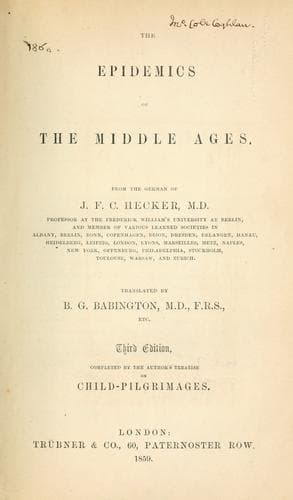
The Epidemics of the Middle AgesHecker, J. F. C. (Justus Friedrich Carl)
History
The Epidemics of the Middle Ages
Hecker, J. F. C. (Justus Friedrich Carl)
Black Death; Epidemics -- History; Hysteria, Epidemic
Four other epidemics similar to that of 1510 appeared in the sixteenth
century, two which were quite general in the years 1557 and 1580, and
two less extensively prevalent in the years 1551 and 1564[477]. Of
the two former we possess accurate descriptions; it will therefore
aid us in forming a correct judgment respecting the influenza
of 1510, if we here take a review of these also, since the most
experienced contemporaries classed all these disorders together as of
a similar kind. During the dry unfavourable summer of 1557, invalids
were suddenly seized with hoarseness and oppression at the chest,
accompanied with a pressure on the head, and followed by shivering and
such a violent cough, that they thought they should be suffocated,
especially during the night. This cough was dry at first, but about the
seventh day, or even later, an abundant secretion took place either
of thick mucus or of thin frothy fluid. Upon this the cough somewhat
abated, and the breathing became freer. During the whole course of
the disorder, however, patients complained of insufferable languor,
loss of strength, want of appetite and even nausea at the sight of
food, restlessness and want of sleep. The malady ended in most cases
in abundant perspiration, but occasionally in diarrhœa. Rich and
poor, people of every occupation and of all ages, were seized with
this disease in whole crowds simultaneously, and it passed easily
from a single case to a whole household. On this occasion death
rarely occurred, except in children who had not power to endure the
severity of the cough, and medicine was of little avail, either in
alleviating the disorder or arresting its destructive course. The
already established name of this disease was immediately called to
mind again in France. It was not, however, confined to that kingdom,
but prevailed as generally, with some considerable varieties of form,
in Italy, Germany, Holland, and doubtless over a still wider range of
country[478]. The same was the case with the influenza of 1580, which
spread over the whole of Europe, and seems to have been less severe;
thus bearing a closer resemblance[479] to that of 1831 and 1833,
which is still in the recollection of most of our readers from their
own experience. A more elaborate research into this very important
subject would far surpass the limits of this treatise, for phenomena
deeply affecting the whole system of human collective life are here
to be considered, which can only become apparent when received as a
connected whole, yet we must at least point out the relation which the
influenzas bear to the greater epidemics. This is quite apparent; for
as catarrhs are not unfrequently the forerunners, accompaniments or
sequelæ of important diseases in individual cases[480], excitement of
the mucous membrane being often merely an outward sign of more deeply
seated commotion, so also are influenzas usually only the _first
manifestations, but sometimes also the last remains of extensive
Public-domain text, read in full here on John Shaqi.
Reviews
Reviews
No reviews yet
Be the first to share your thoughts on this work.
Elsewhere in the archive
Join the Discussion
Join the discussion
Sign in to leave a comment or review.
Sign InorCreate an account