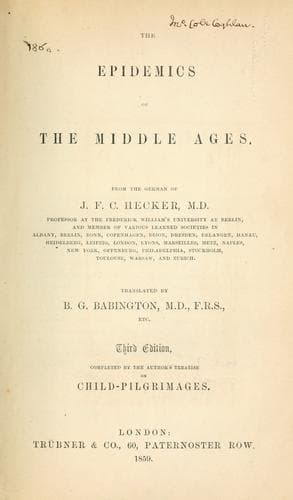
The Epidemics of the Middle AgesHecker, J. F. C. (Justus Friedrich Carl)
History
The Epidemics of the Middle Ages
Hecker, J. F. C. (Justus Friedrich Carl)
Black Death; Epidemics -- History; Hysteria, Epidemic
explanation to a medical man of the present day, from the fissures and
small ulcers of the tongue, which appeared when the fever was at its
height, and obstinately resisted the usual treatment.
The remedies employed shew the circumspection and ability of the Dutch
physicians. They had recourse, as soon as possible, at the latest
within six hours, to venesection, and followed this up immediately
by purgatives, of which, however, some eminent men disapproved,
and this to the great detriment of their patients, for without the
combined effect of both these means, the sudden suffocation could not
be averted. Moreover, the employment of detergent gargles, whereby
the extension of the affection to the lungs was prevented, as also
of demulcent pectoral remedies, was decidedly beneficial, and it is
affirmed that all who were thus treated were easily restored[485].
Extraordinary and peculiar as this disease, for which contemporaries
found no name, was, its rapid onset and its sudden disappearance were
still more so. Most of those affected were taken ill at the same time,
and eleven days of suffering and misery had scarcely elapsed when not
another case occurred; the numbers who had fallen victims were buried;
and but for the journal of the worthy Tyengius[486], no distinct
record would have existed of this remarkable epidemic, which however,
it is certain, spread further than merely over the misty territory of
Holland, and apparently with still greater malignity; for in the same
year we find it in Basle, where, within the space of eight months, it
destroyed about 2000 people, and its symptoms would seem to have been
still more strongly marked. Respecting the intermediate countries,
which it is highly probable that the disease passed through from
Holland before it reached Basle, we unfortunately have no information.
The tongue and gullet were white as if covered with mould, the patient
had an aversion to food and drink, and suffered from malignant fever,
accompanied with continued headache and delirium. Here also, in
addition to an internal method of cure which has not been particularly
detailed, the cleansing of the mouth was perceived to be an essential
part of the treatment: the viscous white coating was removed every two
hours, and the tongue and fauces were afterwards smeared with honey of
roses[487], whereby patients were restored more easily than when this
precaution was omitted[488].
Public-domain text, read in full here on John Shaqi.
Reviews
Reviews
No reviews yet
Be the first to share your thoughts on this work.
Elsewhere in the archive
Join the Discussion
Join the discussion
Sign in to leave a comment or review.
Sign InorCreate an account