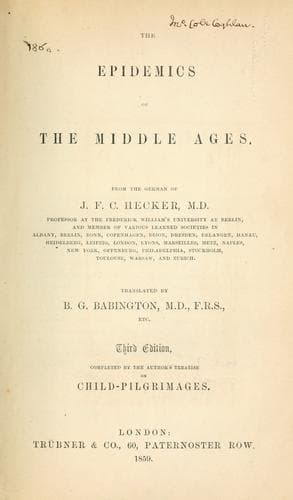
The Epidemics of the Middle AgesHecker, J. F. C. (Justus Friedrich Carl)
History
The Epidemics of the Middle Ages
Hecker, J. F. C. (Justus Friedrich Carl)
Black Death; Epidemics -- History; Hysteria, Epidemic
It appears, according to modern experience, to admit of no doubt that
this disease consisted of an inflammation of the mucous membrane which,
accompanied by a secretion of lymph, spread from the œsophagus to the
stomach, and likewise through the air passages to the lungs, being
thus identical with pharyngeal croup, which was represented a few
years ago as a new disease, and has in consequence been designated by
a special name[489]. Its subsequent appearance in the memorable year
1557, respecting which we have a still more complete account, gives
additional weight to this supposition. In that year it broke out in
October, and was observed by Forest, who was himself the subject of
it, at Alkmaar, where it attacked whole families, and in the course of
a few weeks destroyed more than 200 people. It was not, however, so
excessively rapid in its course as in 1517, but began with a slight
fever like a common catarrh, and shewed its great malignity only by
degrees. Sudden fits of suffocation then came on, and the pain of the
chest was so dreadfully distressing that the sufferers imagined they
must die in the paroxysm. The complaint was increased still more by
a tight convulsive cough, and until this was relieved by a secretion
of mucus, proved dangerous, especially to pregnant women, sixteen of
whom died within the space of eight days, whilst those who survived
were all prematurely brought to bed. The fever which accompanied the
inflammation was very various in its course. It was rarely observed
to continue without intermission, but where this was the case, was
attended with the greatest peril. Yet death did not take place on this
visitation until the ninth or fourteenth day, whereas in the year 1517
as many hours would have sufficed to produce a fatal termination.
After this period the danger diminished, and those patients were most
secure from suffocation, provided they had good medical attendance,
whose complaint had been accompanied throughout its course by fever
of only an intermittent character. So marked was the influence of the
Dutch soil, that until this intermittent passed into continued fever
of different gradations, it appeared of the purest and most unmixed
type. In these cases the inflammation was less completely formed, so
that even bleeding, a remedy otherwise indispensable, was sometimes
unnecessary. Those affected all suffered most at night and in the
morning, the latter generally bringing with it the inflammation of
the larynx and trachea, which, however, they had not at that time
experience enough to recognise as such, perceiving as they did only
a slight redness in the fauces. The painful affection of the stomach
was also in this epidemic very distinctly marked, so that a sense of
pressure at the præcordia, accompanied by continual acid eructations,
continued to exist even after a succession of six or seven fits of
fever; and convalescents were troubled for a long time with dyspepsia,
debility and hypochondriasis.
Public-domain text, read in full here on John Shaqi.
Reviews
Reviews
No reviews yet
Be the first to share your thoughts on this work.
Elsewhere in the archive
Join the Discussion
Join the discussion
Sign in to leave a comment or review.
Sign InorCreate an account