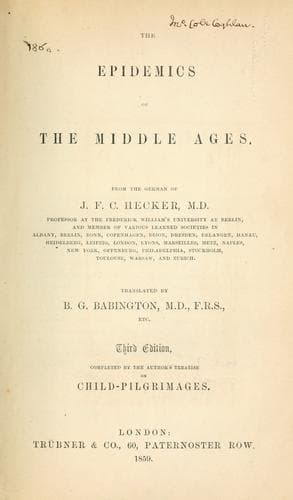
The Epidemics of the Middle AgesHecker, J. F. C. (Justus Friedrich Carl)
History
The Epidemics of the Middle Ages
Hecker, J. F. C. (Justus Friedrich Carl)
Black Death; Epidemics -- History; Hysteria, Epidemic
The inflammation of the mucous membrane,
no doubt, affected the nervous plexuses of the abdomen, as is usually
the case, and totally changed the secretion. This was proved by the
treatment, for, by administering the necessary purgative remedies, a
vast quantity of offensive mucus, mixed with bile, was evacuated.
Our excellent eye-witness assures us that the people sickened as
suddenly as if they had inhaled a poisonous blast, so that more than a
thousand people in Alkmaar betook themselves to their beds in a single
day, a thick stinking mist having previously for several days spread
over the land. This pestilence did not terminate so speedily as that of
the year 1517; on the contrary, it delayed until the winter, and seems
to have formed the conclusion of a whole series of morbid phenomena,
particularly of the already mentioned influenza throughout Europe, and
of the bubo plague in Holland, which had occurred in the middle of
the summer,—phenomena that were accompanied by the usual attendants
of epidemics, namely great scarcity, and unusual occurrences in the
atmosphere, such, for instance, as electric illuminations of prominent
objects, and so forth[490].
The close connexion between this inflammation of the air-passages
and gullet and the epidemic catarrh is quite apparent; for these
are but gradations and gradual transitions in the affection of the
mucous membrane, as also in the power of atmospherical causes, which
especially influence the organs of respiration. We believe, therefore,
that we are fully justified in classing the epidemic described to have
taken place in Holland and Germany in 1517, with the influenzas; and
in declaring the morbid commotion in human collective life which thus
manifested itself, to have been a forerunner of the English pestilence,
which was simultaneously prepared by the altered condition of the
atmosphere, and broke out a few months later.
We ought not to omit here to mention that, in this same year, 1517, the
small-pox, and with it, as field-poppies among corn, the measles, was
conveyed by Europeans to Hispaniola, and committed dreadful ravages at
that time, as afterwards, among the unfortunate inhabitants. Whether
the eruption of these infectious diseases in the new world was favoured
by an epidemic influence or not, can no longer be ascertained; yet the
affirmative seems probable from the fact, that the small-pox did not
commit its greatest ravages in Hispaniola[491] until the following
year, and, according to recent experience, those epidemic influences
which extend from Europe westward, always require some time to reach
the eastern coasts of America.
Public-domain text, read in full here on John Shaqi.
Reviews
Reviews
No reviews yet
Be the first to share your thoughts on this work.
Elsewhere in the archive
Join the Discussion
Join the discussion
Sign in to leave a comment or review.
Sign InorCreate an account