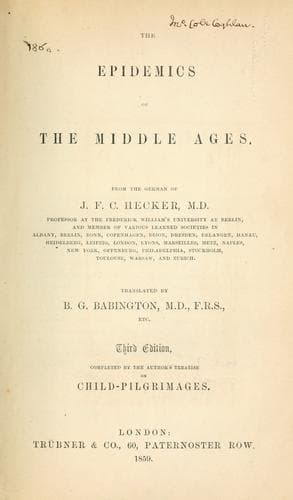
The Epidemics of the Middle AgesHecker, J. F. C. (Justus Friedrich Carl)
History
The Epidemics of the Middle Ages
Hecker, J. F. C. (Justus Friedrich Carl)
Black Death; Epidemics -- History; Hysteria, Epidemic
Finally, in Russia the plague appeared two years later than in Southern
Europe; yet here again, with the same symptoms as elsewhere. Russian
contemporaries have recorded that it began with rigor, heat, and
darting pain in the shoulders and back; that it was accompanied by
spitting of blood, and terminated fatally in two, or at most, three
days. It is not till the year 1360, that we find buboes mentioned as
occurring in the neck, in the axillæ and in the groins, which are
stated to have broken out when the spitting of blood had continued some
time. According to the experience of Western Europe, however, it cannot
be assumed that these symptoms did not appear at an earlier period[28].
Thus much, from authentic sources, on the nature of the Black Death.
The descriptions which have been communicated contain, with a few
unimportant exceptions, all the symptoms of the oriental plague which
have been observed in more modern times. No doubt can obtain on this
point. The facts are placed clearly before our eyes. We must, however,
bear in mind that this violent disease does not always appear in the
same form, and that while the essence of the poison which it produces,
and which is separated so abundantly from the body of the patient,
remains unchanged, it is proteiform in its varieties, from the almost
imperceptible vesicle, unaccompanied by fever, which exists for some
time before it extends its poison inwardly, and then excites fever and
buboes, to the fatal form in which carbuncular inflammations fall upon
the most important viscera.
Public-domain text, read in full here on John Shaqi.
Reviews
Reviews
No reviews yet
Be the first to share your thoughts on this work.
Join the Discussion
Join the discussion
Sign in to leave a comment or review.
Sign InorCreate an account