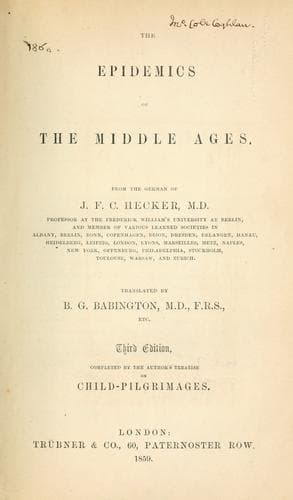
The Epidemics of the Middle AgesHecker, J. F. C. (Justus Friedrich Carl)
History
The Epidemics of the Middle Ages
Hecker, J. F. C. (Justus Friedrich Carl)
Black Death; Epidemics -- History; Hysteria, Epidemic
Deeply as the irreparable loss of such an army was felt by the French,
yet were they destined to suffer still greater misfortunes at home.
The dark power which threatened all Europe regarded neither distance
nor limits. It seized on the French nation in their own country whilst
their military youth were destroyed before Naples. The cold spring
and wet summer of 1528 destroyed the growing corn[521], and a famine
was thus produced throughout France, even more grievous, on account
of its duration, than the period of scarcity in the time of Louis the
XIth[522], for the failure of the harvest continued for five years
in succession, during which all order of the seasons seemed to have
ceased. A damp summer heat prevailed in autumn and winter, a frost of
a single day only occasionally intervening. The summer, on the other
hand, was cloudy, damp, and ungenial. The length of the days alone
distinguished one month from another. It appears plainly from detached
accounts how much the usual course of vegetation was disturbed.
Scarcely had the fruit trees shed their leaves in the autumn when they
began to bud again, and to bear fruitless blossoms. No returns rewarded
the toil of the husbandman, and the longed-for harvest again and again
deceived the hopes of the people. Thus, even during the first of these
calamitous years, the distress became general, and the increasing
indigence was no longer to be checked by human aid. Bands of beggars
wandered over the country in lamentable procession. The bonds of civil
order became more and more relaxed, and people soon had to fear not
only robbery and plunder on the part of these unfortunate beings, but
the contagion of a pestilence, the offspring of their distress, which
followed in their train.
This disease was a new production of the French soil, and when it
spread generally throughout the country, was the more sensibly felt,
as it especially carried off young and robust men; on which account it
was designated by the very significant name of Trousse-Galant[523].
It consisted of a highly inflammatory fever, which destroyed its
victims in a very short time, even within the space of a few hours;
or, if they escaped with their lives, deprived them of their hair
and nails, and from a long-continued disinclination for all animal
food, left behind it, as sequelæ, a protracted debility and diseases
which endangered the recovery of the sick, whose constitutions were
already so much shaken. Hence it appears that this fever was combined
with a great decomposition of the fluids, and a very morbid condition
of the functions of the bowels, not to mention the effects produced
by continued hunger, which contemporaries paint in the most dreadful
colours.
Public-domain text, read in full here on John Shaqi.
Reviews
Reviews
No reviews yet
Be the first to share your thoughts on this work.
Elsewhere in the archive
Join the Discussion
Join the discussion
Sign in to leave a comment or review.
Sign InorCreate an account