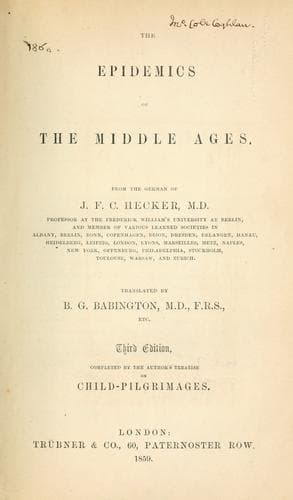
The Epidemics of the Middle AgesHecker, J. F. C. (Justus Friedrich Carl)
History
The Epidemics of the Middle Ages
Hecker, J. F. C. (Justus Friedrich Carl)
Black Death; Epidemics -- History; Hysteria, Epidemic
The stock of provisions was already so far consumed in the first year
that people made bread of acorns, and sought with avidity all kinds of
harmless roots, merely to appease hunger. These miserable sufferers
wandered about, houseless and more like corpses than living beings, and
finally, failing even to excite commiseration, perished on dunghills
or in out-houses. The larger towns shut their gates against them, and
the various charitable institutions proved, of necessity, insufficient
to afford relief in this frightful extremity! It was the lot of very
few to obtain the tender care and attendance of the Sisters of Charity.
In most of those affected their livid swollen countenances, and the
dropsical swelling of their limbs, betrayed the sickly condition in
which they dragged on their languishing existence. Every one fled from
these pestiferous spectres, for they were saturated with the poison of
this deadly disease, and the remark was no doubt made a thousand times
over, that this poison might be conveyed to persons in health without
affecting the carrier, since want and ill health occasionally afford a
miserable protection against disease of this kind[524].
The necessary data for furnishing a complete account of the
Trousse-galant of 1528 do not exist, for physicians passed over this
epidemic with the same coolness and indifference which unfortunately
they may be justly accused of having shewn with respect to other
important phenomena. But it returned once again in 1545–46, appearing
in Savoy and over a great part of France; and we possess from
Paré[525], and from Sander, a Flemish physician[526], though still a
defective, yet a more satisfactory description of its symptoms on this
occasion. Its course was, as before, very rapid, so that it destroyed
the patient in two or three days; again it attacked the strong rather
than the weak, as if in justification of its old name, and those who
recovered remained for a long time distinguishable by the loss of their
hair and their wretched appearance. Patients felt at the commencement
an insufferable weight in the body, with extremely violent headache,
which soon deprived them of all consciousness and passed into a
profound stupor, even the sphincter muscles losing their power. In
other cases a continued state of sleeplessness was followed by feverish
delirium, so violent that it was necessary to have recourse to means
of restraint. Such opposite states are usual in all typhous fevers.
_Sander_ expressly mentions that in most of those affected, eruptions
made their appearance. He does not, however, state their nature or
describe the course and crisis of the disease otherwise than that it
terminated about the fourth or the eleventh day. Even the eruptions
that did appear, which were probably petechiæ, and perhaps also (rother
friesel) red miliary vesicles, came at an indefinite period; either
at the commencement, when they afforded an unfavourable prognosis,
Public-domain text, read in full here on John Shaqi.
Reviews
Reviews
No reviews yet
Be the first to share your thoughts on this work.
Elsewhere in the archive
Join the Discussion
Join the discussion
Sign in to leave a comment or review.
Sign InorCreate an account