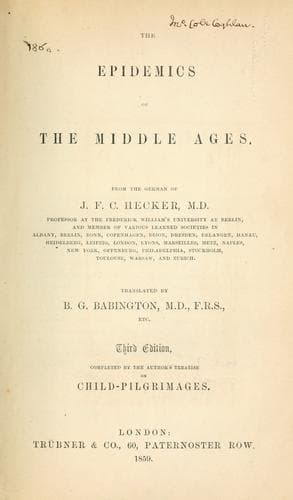
The Epidemics of the Middle AgesHecker, J. F. C. (Justus Friedrich Carl)
History
The Epidemics of the Middle Ages
Hecker, J. F. C. (Justus Friedrich Carl)
Black Death; Epidemics -- History; Hysteria, Epidemic
As soon as the occurrences of this unfortunate year could be more
closely surveyed, a conviction was at once felt, that _it was one and
the same general cause of disease which called forth the poisonous
pestilence in the French camp before Naples, the putrid fever among
the youth in France, and the sweating sickness in England, and that
the varying nature of these diseases depended only on the conditions
of the soil and the qualities of the atmosphere in the countries which
were visited_[537]. If, in opposition to these notions, a narrow view
of human life in the aggregate should raise a doubt, this would be
strikingly refuted by the wonderful coincidence, in point of time,
of all these phenomena, occurring in such various parts of Europe;
for while the French army, after an exposure of four weeks to the
miseries and poisonous vapours of its camp before Naples, perceived
the first forebodings of its destruction, the great famine with the
Trousse-galant in its train was in full advance on the other side the
Alps, and almost on the same day the Sweating Sickness broke out upon
the Thames.
SECT. 4.—NATURAL OCCURRENCES.—PROGNOSTICS.
The chronicles of all the nations of Europe are full of remarkable
notices respecting the commotions of nature in these particular years,
which were so utterly hostile to the animal and vegetable kingdoms. In
England the period of distress was already approaching; towards the end
of the year 1527. Throughout the whole winter, (November and December,
1527, and January, 1528,) heavy rains deluged the country, the rivers
overflowed their banks, and the winter seed was thus rotted. The
weather then remained dry until April; but scarcely was the summer seed
sown, when the rain again set in, and continued day and night for full
eight weeks, so that the last hope of a harvest was now destroyed[538],
and the soaked earth, in the thick mists that arose from its surface,
hatched the well known demon of the Sweating Disease. It was now of no
avail that the torrents of rain ceased, for the softened soil gave the
pestilence constant nourishment, and the damp warmth which, alternating
with unseasonable cold, remained prevalent during the following years
all over Europe, rendered men’s bodies more and more susceptible to
severe diseases.
The historians of that time were too much occupied with the intricate
affairs of the court and of the church to devote any attention
to nature, and on this account they have left us no satisfactory
information of the state of the weather and the course of the seasons
of those years in England, yet there is no reason to suppose that they
were essentially different from those of the rest of Europe. This may
be proved by the following collection of important natural occurrences,
when taken in conjunction with the circumstances already stated
respecting France and Italy.
Public-domain text, read in full here on John Shaqi.
Reviews
Reviews
No reviews yet
Be the first to share your thoughts on this work.
Elsewhere in the archive
Join the Discussion
Join the discussion
Sign in to leave a comment or review.
Sign InorCreate an account