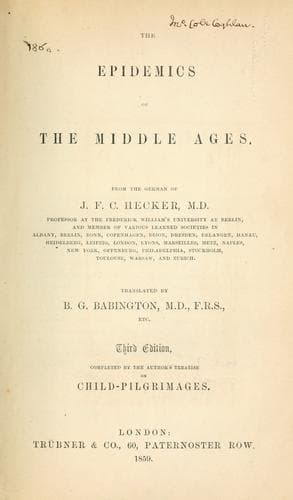
The Epidemics of the Middle AgesHecker, J. F. C. (Justus Friedrich Carl)
History
The Epidemics of the Middle Ages
Hecker, J. F. C. (Justus Friedrich Carl)
Black Death; Epidemics -- History; Hysteria, Epidemic
A heavier affliction than has yet been described was in store for
England: for in the latter end of May, the Sweating Fever broke out
there in the midst of the most populous part of the capital, spreading
rapidly over the whole kingdom; and fourteen months later, brought
a scene of horror upon all the nations of northern Europe, scarcely
equalled during any other epidemic. It appeared at once with the same
intensity as it had shewn eleven years before, was ushered in by no
previous indications, and between health and death there lay but a
brief term of five or six hours. Public business was postponed: the
courts were closed, and four weeks after the pestilence broke out,
the festival of St. John[531] was stopped, to the great sorrow of the
people, who certainly would not have dispensed with its celebration
had they recovered from the consternation arising from the great
mortality. The king’s court was again deserted, and to the various
passions and mental emotions which had been clashing there since
the year 1517, as, for instance, those arising from the theological
zeal which had been excited by Henry VIIIth’s defence of the faith,
was added once more the old alarm and distress, which seemed to be
justified by the death of some favoured courtiers; particularly of two
chamberlains[532], and of Sir Francis Poynes, who had just returned
from an embassy to Spain. The king left London immediately, and
endeavoured to avoid the epidemic by continually travelling, until at
last he grew tired of so unsettled a life, and determined to await his
destiny at Tytynhangar. Here, with his first wife and a few confidents,
he resided quietly, apart from the world, surrounded by fires for
the purification of the air, and guarded by the precautions of his
physician, who had the satisfaction to find that the pestilence kept
aloof from this lonely residence[533].
How many lives were lost in this, which some historians have called
_the great mortality_, can be estimated only by the facts which
have been stated, and which betoken an uncommonly violent degree of
agitation in men’s minds. Accurate data are altogether wanting, yet
it is quite evident that the whole English nation, from the monarch
to the meanest peasant, was impressed with a feeling of alarm at the
uncertainty of life, to which neither the rude state of society, nor a
constant familiarity with the effects of laws written in blood[534],
had blunted their sensibility. Such a state does not exist without
very numerous cases of mortality which bring the danger home to
every individual, so that it is to be presumed that the churchyards
were everywhere abundantly filled. Nor did this destructive epidemic
come alone. Provisions were scarce and dear, and whilst hundreds of
thousands lay stretched upon the bed of death, many perished with
hunger[535], and the same scenes would have been experienced as in
France, had not the corn trade afforded some relief[536].
Public-domain text, read in full here on John Shaqi.
Reviews
Reviews
No reviews yet
Be the first to share your thoughts on this work.
Elsewhere in the archive
Join the Discussion
Join the discussion
Sign in to leave a comment or review.
Sign InorCreate an account