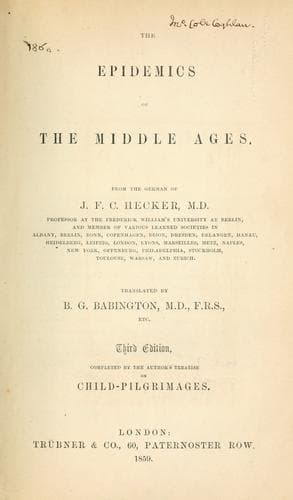
The Epidemics of the Middle AgesHecker, J. F. C. (Justus Friedrich Carl)
History
The Epidemics of the Middle Ages
Hecker, J. F. C. (Justus Friedrich Carl)
Black Death; Epidemics -- History; Hysteria, Epidemic
meeting of the reformers at Marburg, on the 2d of October, had led to
no union among them, because a panic at the new disease had seized the
heretics[627]. Never did a dastardly fear of death enter the heart
of Luther, who, when the plague broke out at Wittenburg in 1527,
cheerfully and courageously remained at his post whilst all around him
fled, and the high school was removed to Jena. Moreover, as we have
seen, the Sweating Sickness never once came near Marburg, and the union
of the two evangelical churches failed on totally different grounds.
In Cologne the zealots were of opinion that they ought to endeavour to
appease the visible wrath of God by the punishment of the heretics,
and it was this sanguinary delusion, worthy of savage barbarians,
which hastened the burning of Flistedt and Clarenbach[628]. To the
completion of this picture of the times, many other minor touches might
be added, of which the following may be taken as an example. In the
March of Brandenburg the evangelical faith, notwithstanding great
obstacles, spread every day more and more, and the Catholic priests
soon found themselves deserted. Just as the Sweating Sickness broke out
at Friedeberg, in the Newmark, a curate there delivered a sermon full
of enthusiasm and passion, and endeavoured to convince his apostate
congregation that God had invented a new plague in order to chastise
the new heresy. A solemn procession, according to ancient usage and
orthodox prescription, was to be held on the following day, and thus
the congregation was to be led back into the bosom of the only true
church. But behold, in the course of the night, the zealous curate died
of some sudden disease; and as mankind are ever ready to interpret even
the thunders of the Eternal according to their own wishes and narrow
notions, the Protestants, it seems, did not fail in their turn to
represent this event as a miracle[629].
SECT. 10.—THE PHYSICIANS.
Public-domain text, read in full here on John Shaqi.
Reviews
Reviews
No reviews yet
Be the first to share your thoughts on this work.
Elsewhere in the archive
Join the Discussion
Join the discussion
Sign in to leave a comment or review.
Sign InorCreate an account