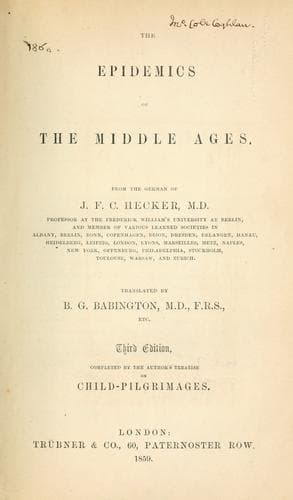
The Epidemics of the Middle AgesHecker, J. F. C. (Justus Friedrich Carl)
History
The Epidemics of the Middle Ages
Hecker, J. F. C. (Justus Friedrich Carl)
Black Death; Epidemics -- History; Hysteria, Epidemic
In the north of Germany another struggle was to be decided. The
evangelical party wished to declare their faith before the empire and
its ruler, to reveal the object of their efforts, and to defend the
purity of their creed against danger and assault. For this purpose
they prepared themselves with wise discretion, and in the measures
taken by the reformers for the fortification of the great work, not
the slightest trace was to be observed of the anxiety which at that
time agitated the people. In the midst of a country whose inhabitants
trembled at the new disease, and were perhaps already severely
afflicted with it, did Luther, whilst at Marburg[624], sketch the first
outlines of a profession of faith, which, as filled up by Melancthon,
has become the foundation-stone of the evangelical church; and in the
following spring, during his stay at Cobourg, he composed his sublime
hymn, “Eine feste burg ist unser Gott,” a strong fortress is our God.
It could not but happen that, in the religious struggles which took
place in these years, especial importance would be attributed to
the English pestilence. Epidemics readily appear to man, in the
narrow circle of his view, as scourges of God; and, indeed, this
representation of them has ever been the prevailing one in all
religions. For it is easier to estimate the ever-existing sins of
humanity than the grand commotions comprehending both mind and body,
of a terrestrial organism, which can only be perceived by a superior
insight into things; and the mean selfishness of mankind and their
delusions respecting their own qualities induce them to adopt the more
easily the partial view, that the Supreme Being allows pestilences to
exist only to destroy their enemies of another faith. On this account,
not only do most contemporary writers speak of the just wrath of God,
and of the chastisement thus prepared for the sins of the world[625],
but the papal party took every possible pains to represent the English
pestilence as a punishment for heresy and an evident warning against
the triumphant doctrines of Luther. The cases in Hamburgh, where the
eruption of the Sweating Sickness almost immediately followed the
abolition of the monasteries, may certainly have obtained credit for
such representations among the wavering and short-sighted, and, in a
hundred other towns also, the Papists may have taken advantage of a
similar occurrence of circumstances, for 1529 was a year when great
and important questions were decided. At Lübeck, the monks in general
preached that the English sweating fever was but a punishment which
heaven inflicted on the Martineans, for so they called the followers
of Luther, and the people were not undeceived until they saw with
astonishment that Catholics also fell sick and died[626]. They went,
however, much further, and did not hesitate to employ even falsehood
and cruel revenge to gain their ends. Thus it was asserted that the
Public-domain text, read in full here on John Shaqi.
Reviews
Reviews
No reviews yet
Be the first to share your thoughts on this work.
Elsewhere in the archive
Join the Discussion
Join the discussion
Sign in to leave a comment or review.
Sign InorCreate an account