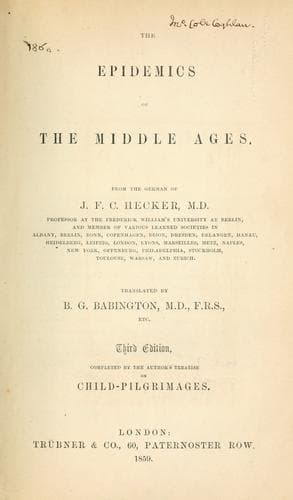
The Epidemics of the Middle AgesHecker, J. F. C. (Justus Friedrich Carl)
History
The Epidemics of the Middle Ages
Hecker, J. F. C. (Justus Friedrich Carl)
Black Death; Epidemics -- History; Hysteria, Epidemic
It is remarkable that during this violent disorder neither the
_activity of the kidneys nor the evacuation by stool was entirely
interrupted_, for there passed continually turbid and dark urine,
although, as may be conceived, in small quantity and with great
uncertainty as to the prognosis; whereupon those physicians who judged
by the urine were not a little perplexed[707]. It was observed, too,
sometimes in the more easily curable cases, _that patients at the
moment when the perspiration broke out upon them passed urine in
great quantity_[708], on which account a French physician proposed to
draw off the water in those who suffered from this disease[709]; yet
this practice has no higher therapeutical worth than the excitement
of perspiration in diabetes or in cholera, and is, moreover, much
less practicable. That occasionally diarrhœa supervened, and even to
a degree which was not to be restrained, may be gathered from the
frequent medical directions as to how it ought to be arrested, which
Kaye also repeats[710]. In some patients, likewise, nature appears to
have effected a simultaneous crisis by the skin, the kidneys, and the
bowels.
Much more important, however, is the observation of a respectable Dutch
physician, that _after the perspiration was over_ there appeared on the
limbs _small vesicles_[711], which were not confluent, but rendered
the skin uneven, and these were not noticed by any other medical
observer, but are spoken of by the author of an old Hamburgh chronicle,
and, with this addition, that they had been seen on the dead[712]. By
these it is very likely that a _miliary eruption_, and perhaps spots
also, are to be understood; yet every thing militates against the
supposition that this phenomenon was constant, or that the Sweating
Fever was an eruptive disorder[713]. For in that case, some mention
would have been made of it in the numerous accounts of historians, many
of whom, doubtless, had themselves seen the disease, and the eruptions
would have been more evidently and decidedly formed in the numerous
relapses of those who recovered. They certainly indicate a relationship
with the miliary fever, but only in so far as that both diseases are
of rheumatic origin, and this slight participation in the nature of
an eruptive disease would seem to have been observed in the English
Sweating Sickness only in perfectly isolated cases. What would have
taken place under such an indication had the Sweating Sickness run a
longer course, whether, in fact, it might not possibly have passed
into a regular miliary fever, is a question unsolved by the past,
since even later transitions of this kind have never been observed.
The two diseases are, both in their course and their nature, perfectly
distinct from each other, and the miliary fever was not developed as an
independent epidemic until the following century, under circumstances
altogether different, and its more decided precursors are not to be
Public-domain text, read in full here on John Shaqi.
Reviews
Reviews
No reviews yet
Be the first to share your thoughts on this work.
Elsewhere in the archive
Join the Discussion
Join the discussion
Sign in to leave a comment or review.
Sign InorCreate an account