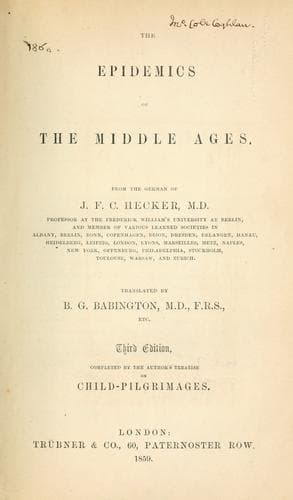
The Epidemics of the Middle AgesHecker, J. F. C. (Justus Friedrich Carl)
History
The Epidemics of the Middle Ages
Hecker, J. F. C. (Justus Friedrich Carl)
Black Death; Epidemics -- History; Hysteria, Epidemic
Such is the testimony of the contemporary writers of 1529, to whose
accounts but little is added by Kaye, an English eye-witness of the
epidemic Sweating Sickness of 1551. The observations of this perfectly
trustworthy physician, so far as they relate to the form of the
disorder, may be here annexed, since no essential differences between
the diseases on these two occasions can be discovered. At the first
onset the disease in some attacked the neck or shoulders, and in others
one leg or one arm, with dragging pains[701]; others felt at the
same time a warm glow that spread itself over the limbs, immediately
after which, without any visible cause, the perspiration broke out,
accompanied by constant and increasing heat of the inward parts,
gradually extending towards the surface. The patients suffered from
a very _quick and irritable pulse_[702] and great thirst, and threw
themselves about in the utmost restlessness. Under the violent headache
which they suffered, they frequently fell into a talkative state of
wandering, yet this did not generally happen before the ninth hour,
and in very various gradations of mental aberration[703], after which
the drowsiness commenced. In others the sweating was longer delayed,
while, in the mean time, a slight rigor of the limbs existed: it then
broke out profusely, but did not always trickle down the skin in equal
abundance, but alternately, sometimes more, sometimes less. It was
thick and of various colours, but in all cases of a very disagreeable
odour[704], which, when it broke out again, after any interruption to
its flow, was still more penetrating[705].
Kaye adds to what we already know of the oppression of the chest, the
very important statement that those affected were observed to have
a _whining, sighing voice_, whence we have every reason to conclude
that there was a serious affection of the eighth pair of nerves. He,
moreover, describes a very mild form of the disease, such as was
prevalent in the south of Germany in 1529. It passed off under proper
care, without any danger, in the very short period of _fifteen hours_,
and was brought to a termination by moderate heat through the medium of
a very gentle perspiration[706].
Public-domain text, read in full here on John Shaqi.
Reviews
Reviews
No reviews yet
Be the first to share your thoughts on this work.
Elsewhere in the archive
Join the Discussion
Join the discussion
Sign in to leave a comment or review.
Sign InorCreate an account