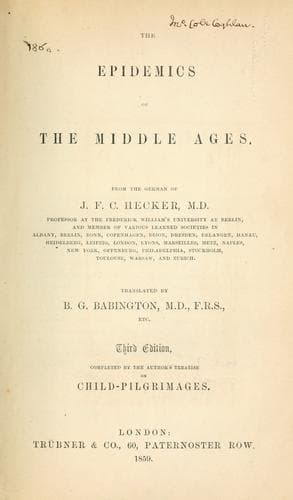
The Epidemics of the Middle AgesHecker, J. F. C. (Justus Friedrich Carl)
History
The Epidemics of the Middle Ages
Hecker, J. F. C. (Justus Friedrich Carl)
Black Death; Epidemics -- History; Hysteria, Epidemic
How great the decomposition of the organic matter was is convincingly
proved from all the testimony hitherto adduced, but it might have
been inferred from the very rapid putrefaction of the body, which
rendered it necessary everywhere to use the greatest despatch in the
performance of burials[719]; and fortunately did away with all fear of
being buried alive. Of post mortem examinations we have no information,
and even if they could have been instituted, they would, from the
manner of conducting researches in those times, scarcely have thrown
any important light on the disease. Hardly any physicians but those
who had studied in Italy knew the inward structure of the body from
their own observation, superficial as it was; the rest learned it
only from Galenic manuals; how could they with such slender knowledge
have distinguished between healthy and diseased parts? Moreover, the
Sweating Sickness could not in so short a period cause such a palpable
and substantial destruction of the viscera as they would alone have
sought for. Details respecting the condition of the blood in the dead
body, which after such an enormous loss of watery fluid, such severe
oppression at the chest, and so great an impediment to the function
of respiration, would in all probability be thickened and darkened in
colour, as well as respecting the condition of the lungs and of the
heart, it would be highly desirable to obtain; but these likewise are
wanting altogether, and after the lapse of so long a period there only
remains room for conjectures.
The observation was repeated in Germany which had been so frequently
made since the year 1485, that the middle period of life was especially
exposed to the Sweating Fever. Children, on the contrary, remained
almost entirely exempt from this disease, and when the aged were
affected by it, it was as individual exceptions to a general rule[720],
and this as it would appear, only during the height of the epidemic; as
for example at Zwickau, where a woman of 112 years of age was carried
off by it[721]. We have already in part discovered the cause of this
perfectly constant phenomenon in the luxurious mode of living of robust
young men, and if we look back to the moral condition of the Germans
in the 16th century, we find among them the same immoderate luxury
as among the English, the same drunkenness, the same intemperance at
their frequent banquets, where the wine-cups and beer-jugs were emptied
with but too eager draughts; finally, also, the same relaxation of
skin consequent upon the use of warm baths and warm clothing. All
contemporary writers mention these circumstances[722], and our bold
forefathers, with respect to these matters, were not in the best repute
with their southern neighbours.
Public-domain text, read in full here on John Shaqi.
Reviews
Reviews
No reviews yet
Be the first to share your thoughts on this work.
Elsewhere in the archive
Join the Discussion
Join the discussion
Sign in to leave a comment or review.
Sign InorCreate an account