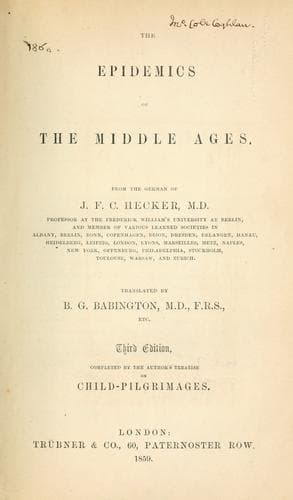
The Epidemics of the Middle AgesHecker, J. F. C. (Justus Friedrich Carl)
History
The Epidemics of the Middle Ages
Hecker, J. F. C. (Justus Friedrich Carl)
Black Death; Epidemics -- History; Hysteria, Epidemic
But we have, moreover, to survey the disease in another point of
view, namely, in relation to its peculiar character. In the outset we
designated _the Sweating Sickness as a rheumatic fever_, and if we take
the notion of a rheumatic affection, as in propriety we ought, in its
widest acceptation, weighty and convincing grounds have been adduced
in the course of our whole inquiry in confirmation of this view. When
we observe that those very nations were visited by the Sweating Fever,
which are characterized by a fair skin, blue eyes, and light hair—the
marks of the German race, it may with justice be assumed, that even
this peculiarity in the structure of the body rendered it susceptible
of this extraordinary disease. It is this which causes the proneness
to fluxes of all kinds, and which makes these diseases endemic in the
north of Europe, whilst the dark-haired southern nations and the blacks
in the tropical climates remain, under similar circumstances[723], more
free from them. If it be remembered further how overcharged with water
were the lower strata of the atmosphere in which the pestilent Sweating
Fevers existed, what thick and even offensive mists prepared the way
for the disease and indicated its approach, what rapid alternations of
freezing cold and excessive heat took place in the summer of 1529; and,
moreover, how frequent all kinds of fluxes were in this very year, the
complete form of the rheumatic constitution will be recognised in every
individual feature.
Did we possess in the showy systems of modern times a maturer knowledge
of the electricity of living bodies, much light would of necessity
hence be thrown on the great object of our research. We should not
then be compelled to rest satisfied with the fact that a cloudy
atmosphere abstracts electricity from the body, robs the skin and
lungs of their electrical atmosphere, disturbs their mutual electrical
relation with the external world, and by this disturbance prepares the
body for rheumatic indisposition, with all that peculiar decomposition
of the fluids, irritable tension of the nerves, fever, and painful
affection of particular parts, with which it is accompanied. If this
disturbance be represented according to certain new and inviting
hypotheses, supported by some important facts[724], as being perhaps
an accumulation of electricity in the interior of the body, owing to a
morbid, isolating activity of the skin, we may expect a more perfect
knowledge of the nature of rheumatism through the medium of future
diligent researches; and until these be made, some evident signs
of connexion between rheumatic affections and the English Sweating
Sickness will perhaps be sufficient to demonstrate the rheumatic nature
of this latter disease.
Public-domain text, read in full here on John Shaqi.
Reviews
Reviews
No reviews yet
Be the first to share your thoughts on this work.
Elsewhere in the archive
Join the Discussion
Join the discussion
Sign in to leave a comment or review.
Sign InorCreate an account