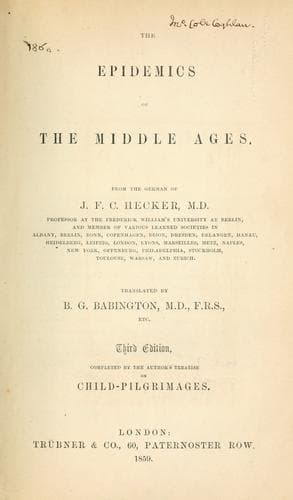
The Epidemics of the Middle AgesHecker, J. F. C. (Justus Friedrich Carl)
History
The Epidemics of the Middle Ages
Hecker, J. F. C. (Justus Friedrich Carl)
Black Death; Epidemics -- History; Hysteria, Epidemic
That he was thus established in London before the year 1551 is certain,
yet he was present in Shrewsbury, during the Sweating Sickness. His
pamphlet[791] upon this disease, the first and last published in
England, did not, however, appear before 1552, after all was over. It
is written in strong language and a popular style, and with a laudable
frankness; for Kaye blames in it, without any reserve, the gross
mode of living of his countrymen, and does not fatigue his reader
with too much book learning, which neither he nor his contemporaries
could refrain from displaying on other occasions. He reserved this
for the Latin version of his pamphlet, which was published four years
later[792], and although, judged according to a modern standard, it is
far from being satisfactory, yet it contains an abundance of valuable
matter, and proves its author to be a good observer; and in this we
can nowhere mistake that he is an Englishman of the sixteenth century,
however numerous the terms he may borrow from Celsus. His doctrines
are of the old Greek school throughout, of which the physicians of
those times were staunch supporters; hence the term _ephemera[793]
pestilens_, his comparison of the disease with the similar fevers of
the ancients[794], and his accurate appreciation of the important
doctrine of æthereal spirits, to which he refers its chief causes,
and, according to which, the corrupted atmosphere (spiritus corrupti)
becomes mixed in the lungs with the spirits of blood, (spiritus
sanguinis,) whence it at once appears explicable to him, why many
persons may be attacked with the Sweating Sickness at the same time,
and even in different places, and why the parts of the body in which,
according to the ancient Greek notion, the æthereal spirits developed
themselves, were most violently affected with this disease[795]. From
the relationship of the infected air to the æthereal spirits in the
body, polluted by intemperance, it also appears explicable to him, why
foreigners in England, in whom this pollution took place in a less
degree, were, only in cases of individual exception, attacked by the
Sweating Sickness[796], not to mention other theoretical notions.
Public-domain text, read in full here on John Shaqi.
Reviews
Reviews
No reviews yet
Be the first to share your thoughts on this work.
Elsewhere in the archive
Join the Discussion
Join the discussion
Sign in to leave a comment or review.
Sign InorCreate an account