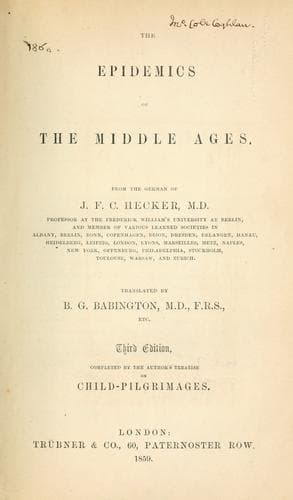
The Epidemics of the Middle AgesHecker, J. F. C. (Justus Friedrich Carl)
History
The Epidemics of the Middle Ages
Hecker, J. F. C. (Justus Friedrich Carl)
Black Death; Epidemics -- History; Hysteria, Epidemic
In 1551 there prevailed in Swabia a disease of the nature of plague,
which determined the Duke Christoph, of Würtemburg, to withdraw
himself from Stuttgard. It did not spread, and seems to have remained
unknown to the rest of Germany[786]. In Spain, too, the plague[787]
shewed itself, and if to this be added the influenza of the same
year[788], as well as the numerous cases of malignant fevers in Germany
and Switzerland, which were spoken of as still existing in the two
following years[789], it will again be seen quite evidently that _the
fifth epidemic Sweating Sickness_ _appeared, accompanied by a group of
various epidemic diseases, which might be considered as resulting from
general influences_. The disease which is the subject of our research
thus took its departure from Europe similarly accompanied as when it
originally sprang up there, while in the interval it thrice repeated
its deadly attacks.
SECT. 5.—JOHN KAYE.
Let us dedicate a few moments to the observer of the fifth sweating
pestilence, whose life presents a lively image of the peculiarities and
tendencies of his age. He was born at Norwich on the 6th of October,
1510, and received his education at Gonville Hall, Cambridge. He had
early evinced by some productions his great knowledge of the Greek
language, and his zeal for theological investigations. At a maturer
age he went to Italy, at that time the seat of scientific learning,
where _Baptista Montanus_ and _Vesalius_, at Padua, initiated him in
the healing art. He took his Doctor’s degree at Bologna, and in 1542 he
lectured on Aristotle in conjunction with Realdus Columbus, with great
approbation. The following year he travelled throughout Italy, and with
much diligence collated manuscripts for the emendation of Galen and
Celsus, attended the prælections of Matthæus Curtius at Pisa, and then
returned through France and Germany to his own country.
After being admitted as a doctor of medicine at Cambridge, he practised
with great distinction at Shrewsbury and Norwich, but was soon summoned
by Henry the Eighth to deliver anatomical lectures to the surgeons in
London. He was much honoured at the court of Edward the Sixth, and the
appointment of body physician, which this monarch bestowed on him, he
retained also under Queen Mary and Elizabeth. In 1547, he became a
Fellow of the College of Physicians, over which, at a later period,
he presided for seven years. He constantly supported the honour of
this body with great zeal, compiled its Annals from the period of
its foundation by Linacre to the end of his own presidentship, and
originated an establishment, the first of the kind in England[790], for
annually performing two public dissections of human bodies.
Public-domain text, read in full here on John Shaqi.
Reviews
Reviews
No reviews yet
Be the first to share your thoughts on this work.
Elsewhere in the archive
Join the Discussion
Join the discussion
Sign in to leave a comment or review.
Sign InorCreate an account