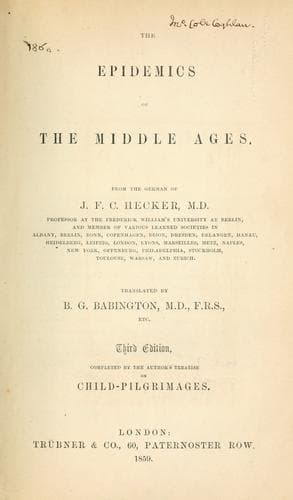
The Epidemics of the Middle AgesHecker, J. F. C. (Justus Friedrich Carl)
History
The Epidemics of the Middle Ages
Hecker, J. F. C. (Justus Friedrich Carl)
Black Death; Epidemics -- History; Hysteria, Epidemic
Kaye’s treatment of the Sweating Sickness is according to the mild old
English plan, which is very judiciously and perspicuously laid down.
He kept himself, on the whole, free from the influence of the schools
in this instance, and the only remedy which he approved in case of
necessity, was a harmless and very favourite preparation of pearls and
odoriferous substances, which was called Manus Christi[802], or, in
Germany, sugar of pearls. It had its origin in the fifteenth century,
and was the invention of _Guainerus_[803], and there were various
receipts for compounding it[804]. He also sometimes prescribed, at
the commencement of the attack[805], bole or terra sigillata, for how
could a physician of the sixteenth century doubt the antipoisonous
effect of this overrated remedy? Restlessness in the patient, debility,
a too thick skin, and thick blood, are set forth by him as the chief
impediments to the critical sweat, and in order to remove them, he
sets to work with great and laudable caution, ordering, according to
circumstances, even mulled wine and greater warmth. Sometimes, too,
he could not refrain from employing Theriac and Mithridate, but he
did not use these remedies to any great extent. For dropsical and
rheumatic patients who became the subjects of the Sweating Sickness,
he prescribed a beverage of Guaiacum; he also recommended as a
sudorific, the China root, which was at that time much in use. When
the perspiration broke out, he positively prohibited the urging it
beyond the proper point; all medicines were thence laid aside, and he
trusted to aromatic vinegar and gentle succussion alone for keeping off
the lethargy, without considering, with _Damianus_, that more severe
measures were essential[806].
Public-domain text, read in full here on John Shaqi.
Reviews
Reviews
No reviews yet
Be the first to share your thoughts on this work.
Elsewhere in the archive
Join the Discussion
Join the discussion
Sign in to leave a comment or review.
Sign InorCreate an account