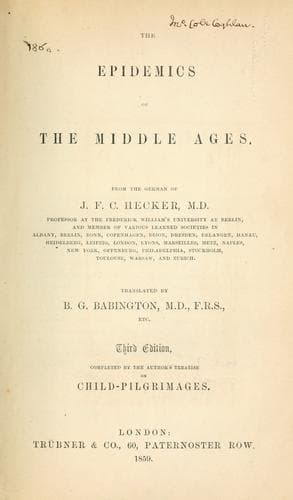
The Epidemics of the Middle AgesHecker, J. F. C. (Justus Friedrich Carl)
History
The Epidemics of the Middle Ages
Hecker, J. F. C. (Justus Friedrich Carl)
Black Death; Epidemics -- History; Hysteria, Epidemic
As a learned patron of the sciences, Kaye ranks amongst the most
distinguished men of his country. Through his interest, Gonville Hall
was, in the reign of _Queen Mary_, elevated to the rank of a college,
better established, and more richly endowed. To the end of his life,
he continued to preside[807] over this his favourite institution,
and passed his old age[808] there, not in Monkish contemplation,
like Linacre, but zealously devoted to study, as the great number of
his writings testifies. He was accused of having changed his faith
according to circumstances. This pliability served, it is true,
to retain him in favour with sovereigns of very opposite modes of
thinking: it is not, however, a sign of elevation of mind, and can only
be explained in part by the spirit of the English Reformation. _Kaye_
was a reformer in fact, inasmuch as he was a promoter of instruction,
and, perhaps, laid no stress on outward profession. His versatility
as a scholar is extraordinary, and would be worthy of the highest
admiration, had he entirely avoided the reproach of credulity, had
he not been too prolix in subordinate matters, and had he shown more
decided signs of genius. At one time he translated and illustrated the
writings of Galen; at another, he wrote on philology or the medical
art—it must be confessed, without much originality, for he took _Galen_
and _Montanus_ as his patterns[809]. But where could physicians
be found at that time who did not follow established doctrines?
Some essays on History and English Archæology are found among his
writings[810]; and his works on Natural History[811], dedicated to
Conrad Gesner, are among the best of his age, because he imparted
his observations in them quite plainly and naturally, free from the
trammels of any school. He died at Cambridge on the 29th of July, 1573,
and ordered for himself the following epitaph-“Fui Caius.”
CHAPTER VI.
SWEATING SICKNESSES.
Ἔστι γὰρ τὸ πάθος λύσις τῶν δεσμῶν τῆς εἰς ζωὴν δυνάμιος.
ARETÆUS.
SECT. 1.—THE CARDIAC DISEASE OF THE ANCIENTS.
(MORBUS CARDIACUS.)
Public-domain text, read in full here on John Shaqi.
Reviews
Reviews
No reviews yet
Be the first to share your thoughts on this work.
Elsewhere in the archive
Join the Discussion
Join the discussion
Sign in to leave a comment or review.
Sign InorCreate an account