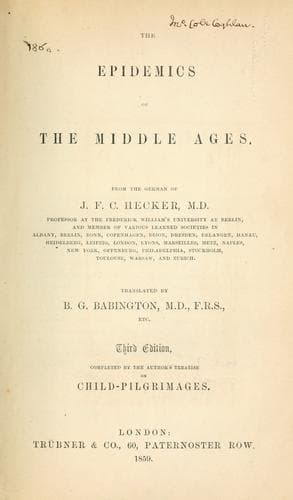
The Epidemics of the Middle AgesHecker, J. F. C. (Justus Friedrich Carl)
History
The Epidemics of the Middle Ages
Hecker, J. F. C. (Justus Friedrich Carl)
Black Death; Epidemics -- History; Hysteria, Epidemic
Guy de Chauliac, considers the influence of the conjunction, which was
held to be all-potent, as the chief general cause of the Black Plague;
and the diseased state of bodies, the corruption of the fluids,
debility, obstruction, and so forth, as the especial subordinate
causes[171]. By these, according to his opinion, the quality of
the air, and of the other elements, was so altered, that they set
poisonous fluids in motion towards the inward parts of the body, in
the same manner as the magnet attracts iron; whence there arose in the
commencement fever and the spitting of blood; afterwards, however, a
deposition in the form of glandular swellings and inflammatory boils.
Herein the notion of an epidemic constitution was set forth clearly,
and conformably to the spirit of the age. Of contagion, Guy de Chauliac
was completely convinced. He sought to protect himself against it by
the usual means[172]; and it was probably he who advised Pope Clement
VI. to shut himself up while the plague lasted. The preservation of
this pope’s life, however, was most beneficial to the city of Avignon,
for he loaded the poor with judicious acts of kindness, took care to
have proper attendants provided, and paid physicians himself to afford
assistance wherever human aid could avail—an advantage which, perhaps,
no other city enjoyed[173]. Nor was the treatment of plague-patients
in Avignon by any means objectionable; for, after the usual depletions
by bleeding and aperients, where circumstances required them, they
endeavoured to bring the buboes to suppuration; they made incisions
into the inflammatory boils, or burned them with a red-hot iron, a
practice which at all times proves salutary, and in the Black Plague
saved many lives. In this city, the Jews, who lived in a state of the
greatest filth, were most severely visited, as also the Spaniards, whom
Chalin accuses of great intemperance[174].
Public-domain text, read in full here on John Shaqi.
Reviews
Reviews
No reviews yet
Be the first to share your thoughts on this work.
Elsewhere in the archive
Join the Discussion
Join the discussion
Sign in to leave a comment or review.
Sign InorCreate an account