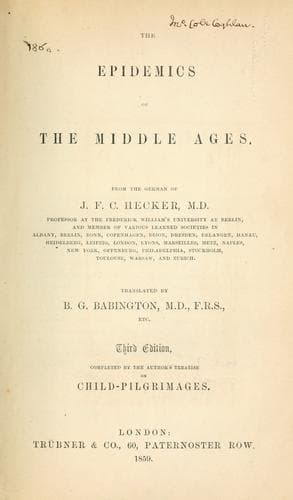
The Epidemics of the Middle AgesHecker, J. F. C. (Justus Friedrich Carl)
History
The Epidemics of the Middle Ages
Hecker, J. F. C. (Justus Friedrich Carl)
Black Death; Epidemics -- History; Hysteria, Epidemic
Still more distinct notions on the causes of the plague were stated
to his contemporaries in the 14th century, by Galeazzo di Santa
Sofia, a learned man, a native of Padua, who likewise treated
plague-patients at Vienna[175], though in what year is undetermined.
He distinguishes carefully _pestilence_ from _epidemy_ and _endemy_.
The common notion of the two first accords exactly with that of an
epidemic constitution, for both consist, according to him, in an
unknown change or corruption of the air; with this difference, that
_pestilence_ calls forth diseases of different kinds; _epidemy_, on
the contrary, always the same disease. As an example of an _epidemy_,
he adduces a cough (influenza) which was observed in all climates
at the same time, without perceptible cause; but he recognised the
approach of a _pestilence_, independently of unusual natural phenomena,
by the more frequent occurrence of various kinds of fever, to which
the modern physicians would assign a nervous and putrid character.
The _endemy_ originates, according to him, only in local telluric
changes—in deleterious influences which develop themselves in the
earth and in the water, without a corruption of the air. These notions
were variously jumbled together in his time, like every thing which
human understanding separates by too fine a line of limitation.
The estimation of cosmical influences, however, in the _epidemy_
and _pestilence_, is well worthy of commendation; and Santa Sofia,
in this respect, not only agrees with the most intelligent persons
of the 14th and 15th centuries, but he has also promulgated an
opinion which must, even now, serve as a foundation for our scarcely
commenced investigations into cosmical influences[176]. _Pestilence_
and _epidemy_, consist not in alterations of the four primary
qualities[177], but in a corruption of the air, powerful, though quite
immaterial, and not cognoscible by the senses:—(corruptio aëris non
substantialis, sed qualitativa) in a disproportion of the imponderables
in the atmosphere, as it would be expressed by the moderns[178]. The
causes of the _pestilence_ and _epidemy_ are, first of all, astral
influences, especially on occasion of planetary conjunctions; then
extensive putrefaction of animal and vegetable bodies, and terrestrial
corruptions (corruptio in terra); to which also, bad diet and want may
contribute. Santa Sofia considers the putrefaction of locusts, that had
perished in the sea, and were again thrown up, combined with astral and
terrestrial influences, as the cause of the pestilence in the eventful
year of the “_Great Mortality_.”
Public-domain text, read in full here on John Shaqi.
Reviews
Reviews
No reviews yet
Be the first to share your thoughts on this work.
Elsewhere in the archive
Join the Discussion
Join the discussion
Sign in to leave a comment or review.
Sign InorCreate an account