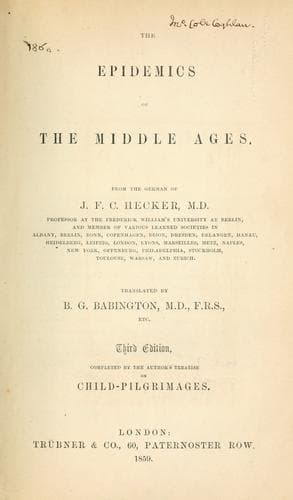
The Epidemics of the Middle AgesHecker, J. F. C. (Justus Friedrich Carl)
History
The Epidemics of the Middle Ages
Hecker, J. F. C. (Justus Friedrich Carl)
Black Death; Epidemics -- History; Hysteria, Epidemic
The first lazarettos were established upon islands at some distance
from the city, seemingly as early as the year 1485. Here all strangers
coming from places where the existence of plague was suspected were
detained. If it appeared in the city itself, the sick were despatched
with their families to what was called the Old Lazaretto, were there
furnished with provisions and medicines, and, when they were cured,
were detained, together with all those who had had intercourse with
them, still forty days longer in the New Lazaretto, situated on another
island. All these regulations were every year improved, and their
needful rigour was increased, so that from the year 1585 onwards, no
appeal was allowed from the sentence of the Council of Health; and
the other commercial nations gradually came to the support of the
Venetians, by adopting corresponding regulations[197]. Bills of health,
however, were not general until the year 1665[198].
The appointment of a forty days’ detention, whence quarantines derive
their name, was not dictated by caprice, but probably had a medical
origin, which is derivable in part from the doctrine of critical
days; for the fortieth day, according to the most ancient notions,
has been always regarded as the last of ardent diseases, and the
limit of separation between these and those which are chronic. It was
the custom to subject lying-in women for forty days to a more exact
superintendence. There was a good deal also said in medical works of
forty day epochs in the formation of the fœtus, not to mention that
the alchymists expected more durable revolutions in forty days, which
period they called the philosophical month.
This period being generally held to prevail in natural processes, it
appeared reasonable to assume, and legally to establish it, as that
required for the development of latent principles of contagion, since
public regulations cannot dispense with decisions of this kind, even
though they should not be wholly justified by the nature of the case.
Great stress has likewise been laid on theological and legal grounds,
which were certainly of greater weight in the fifteenth century than in
more modern times[199].
On this matter, however, we cannot decide, since our only object here
is to point out the origin of a political means of protection against a
disease, which has been the greatest impediment to civilization within
the memory of man; a means, that, like Jenner’s vaccine, after the
small-pox had ravaged Europe for twelve hundred years, has diminished
the check which mortality puts on the progress of civilization, and
thus given to the life and manners of the nations of this part of the
world a new direction, the result of which we cannot foretell.
APPENDIX.
I.
Das alte Geisslerlied
NACH MASSMANN’S AUSGABE VON HERRN PROFESSOR LACHMANN MIT DER
HANDSCHRIFT VERGLICHEN.
Public-domain text, read in full here on John Shaqi.
Reviews
Reviews
No reviews yet
Be the first to share your thoughts on this work.
Elsewhere in the archive
Join the Discussion
Join the discussion
Sign in to leave a comment or review.
Sign InorCreate an account