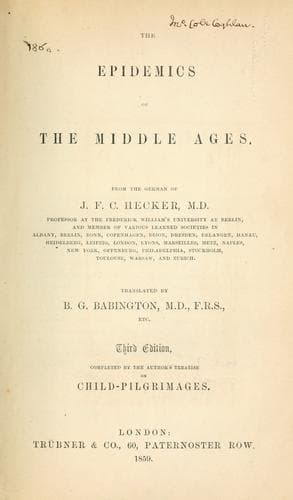
The Epidemics of the Middle AgesHecker, J. F. C. (Justus Friedrich Carl)
History
The Epidemics of the Middle Ages
Hecker, J. F. C. (Justus Friedrich Carl)
Black Death; Epidemics -- History; Hysteria, Epidemic
We cannot precisely perceive in these an advance towards general
regulations; and perhaps people were convinced of the insurmountable
impediments which opposed the separation of open inland countries,
where bodies of people connected together could not be brought, even
by the most obdurate severity, to renounce the habit of a profitable
intercourse.
Doubtless it is nature which has done the most to banish the Oriental
plague from western Europe, where the increasing cultivation of the
earth, and the advancing order in civilized society, have prevented it
from remaining domesticated; which it most probably was in the more
ancient times.
In the 15th century, during which it broke out seventeen times in
different places in Europe[193], it was of the more consequence to
oppose a barrier to its entrance from Asia, Africa, and Greece (which
had become Turkish); for it would have been difficult for it to
maintain itself indigenously any longer. Among the southern commercial
states, however, which were called on to make the greatest exertions to
this end, it was principally Venice, formerly so severely attacked by
the Black Plague, that put the necessary restraint upon the perilous
profits of the merchant. Until towards the end of the 15th century, the
very considerable intercourse with the East was free and unimpeded.
Ships of commercial cities had often brought over the plague: nay, the
former irruption of the “_Great Mortality_” itself had been occasioned
by navigators. For, as in the latter end of Autumn, 1347, four ships
full of plague-patients returned from the Levant to Genoa, the disease
spread itself there with astonishing rapidity. On this account, in the
following year, the Genoese forbad the entrance of suspected ships into
their port. These sailed to Pisa and other cities on the coast, where
already nature had made such mighty preparations for the reception of
the Black Plague, and what we have already described took place in
consequence[194].
In the year 1485, when, among the cities of northern Italy, Milan
especially felt the scourge of the plague, a special council of
health, consisting of three nobles, was established at Venice, who
probably tried every thing in their power to prevent the entrance of
this disease, and gradually called into activity all those regulations
which have served in later times as a pattern for the other southern
states of Europe. Their endeavours were, however, not crowned with
complete success; on which account their powers were increased, in the
year 1504, by granting them the right of life and death over those who
violated the regulations[195]. Bills of health were probably first
introduced in the year 1527, during a fatal plague[196] which visited
Italy for five years (1525–30), and called forth redoubled caution.
Public-domain text, read in full here on John Shaqi.
Reviews
Reviews
No reviews yet
Be the first to share your thoughts on this work.
Elsewhere in the archive
Join the Discussion
Join the discussion
Sign in to leave a comment or review.
Sign InorCreate an account