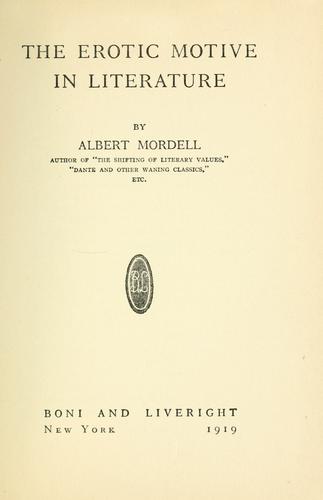
Erotic literature -- History and criticism; Psychoanalysis and literature; Sex in literature
Among the fairy tales of our day are those centring around psychic
phenomena and reporting the conversations of the dead. They are written
because they represent the writer's wishes to communicate with the
dead and to prove that we do not die. They are needed by some in an
era of exact science and a great war as old folk lore was needed in
its time. Needless to say this does not speak well for the intellects
of the writers of these spiritualistic works. We make something occur
because we want it to transpire. Lodge's _Raymond_ is one of the fairy
tales of recent times and it has a genuineness because the author, to
the amazement of many of us, believes those talks with his son actually
took place. The book is really a commentary on his pathetic state of
mind after the death of his son, and is his dream of hope.
But realistic literature is after all in the ascendant, for it tells us
of what we experience in our own life. Don Quixote showed us that love
for books dealing with dreams and impossibilities may help to make one
mad. Men are interested in their inner struggles and in the problems
of the day. Books treating of these have replaced considerably the old
romances as serious literature.
Romantic and idealistic works are like dreams, fragments of the psychic
life of the race when it was young.
II
The literary works that we like best are those which tell of the
frustration of wishes like our own. We prefer to read about troubles
like those we have suffered, to lose ourselves in the dreams and
fantasies built up by authors, akin to those we have conjured up in
our own imagination.
We prefer a book that apologises for us, that tells of strivings and
repressions such as we have experienced. We get a sort of pleasure
then out of painful works, in which our sorrows and wants are put into
artistic form, so as to evoke them again in us. It depends often on
the character of our repression as to the nature of the books we like.
If we have overthrown the authority of our fathers or experienced a
painful love repression because we were hampered by social laws, if we
have broken with our religious friends or been crushed by some moneyed
powers, we may become of a revolutionary trend of mind and hence prefer
writers with radical opinions. In our time there have arisen a number
of geniuses who voiced such opinions; having experienced repressions
on account of the customs of society, they sang and wrote of those
repressions and attacked those customs. The great love felt by the
young man who does not fit into the social order, for writers like
Whitman, Ibsen, Nietzsche, Shaw, and others, is because these writers
approve an individualism that he seeks to cultivate. He who is grieved
by the tyranny of the philistine and the bourgeois, the hypocrite and
the puritan, finds himself consoled by writers who were also victims of
such tyranny.
Public-domain text, read in full here on John Shaqi.
Reviews
Reviews
No reviews yet
Be the first to share your thoughts on this work.
Elsewhere in the archive
Join the Discussion
Join the discussion
Sign in to leave a comment or review.
Sign InorCreate an account