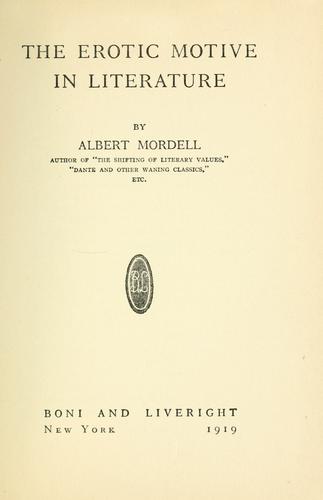
Erotic literature -- History and criticism; Psychoanalysis and literature; Sex in literature
On account of the recent war, many dormant emotions were reanimated in
us and appeared in our literature. People found that Homer's _Iliad_
and other ancient warlike epics appealed to them more than these did
in times of peace. Literature in war times becomes more related to
primitive literature where the hero is the successful, brave warrior.
The military and patriotic spirit had not been extinct, but quiescent.
If Milton had lived in the eighteen nineties he would probably have
written problem plays and novels instead of _Paradise Lost_. He was
unhappily married, but the fashion of his age was not to create
imaginative works based on justifiable causes for seeking a divorce. He
did write on the subject of divorce, however, and his views horrified
his contemporaries. He stood alone. Had the tendencies of the time been
to make works of the imagination out of situations in which he was
personally placed, he would have no doubt done so. In his unconscious
he felt about women and divorce much as Strindberg did. He retained
during the Restoration his early Puritanism and religious interests,
and hence published _Paradise Lost_. Even here he found an opportunity
for expressing special views about women and describing his own forlorn
condition.
Again it is likely that Shakespeare in our generation would not have
written much differently from Ibsen or Hauptmann. The marriage problem
interested him also, for he was unhappily married and loved another.
He expressed his bitterness towards woman in his sonnets, in his
characterisations of historical characters like Cleopatra and Cressida.
But he wrote no special work occupied with the theme of the hard
restrictions placed by society upon the lives of some unhappily married
people. A work of this kind would have been almost a monstrosity in
his age. Shakespeare could not have written exactly as Ibsen did,
for though in their unconscious they were alike, each had different
traditions and backgrounds to work on. No writer ignores totally
prevailing literary fashions or tastes.
Public-domain text, read in full here on John Shaqi.
Reviews
Reviews
No reviews yet
Be the first to share your thoughts on this work.
Elsewhere in the archive
Join the Discussion
Join the discussion
Sign in to leave a comment or review.
Sign InorCreate an account