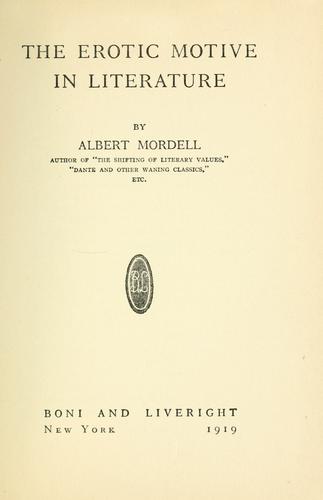
Erotic literature -- History and criticism; Psychoanalysis and literature; Sex in literature
Literature gives each writer or reader the means of choosing his own
father as it were. When a man says he found his whole life changed by a
certain book, it is equivalent to his saying that the book has merely
made him recognise his unconscious; it did not put anything there
that was not there before. The book had a psychoanalytic effect on
him; it taught him to look at his unconscious objectively; it brought
to consciousness something that was repressed. If the resistance to
perceiving that unconscious had not been overcome the book could have
had no effect. We hate a book often because the censorship in us is too
great. When John A. Symonds describes the effects of Whitman's _Leaves
of Grass_, which he says influenced him more than any other book except
the Bible, he meant Whitman cured him of neurosis, brought out his
repressed feelings and made him aware of his inner wants and told him
how to satisfy them.
The saying, "Tell me what you read and I'll tell you what you are,"
is true. People differ about the qualities of books because their own
unconscious wishes have been met differently in these books.
III
What then is the cause of literary movements and what stamps the
peculiarities of a literary age, if all writers draw on their
unconscious? Why does a Pope appear in the age of Queen Anne and a
Wordsworth at the end of the reign of George IV? Why didn't Shakespeare
write in the Elizabethan age like Charles Dickens in the Victorian
period? How account for the warlike character of the Saxon epic
Beowulf, for the religious tone of her first poet, Cædmon; for the
interest in chivalry and allegory in the _Faërie Queen_? What made
Bunyan so absorbed in salvation, in _Pilgrim's Progress_, at the
time the Restoration dramatists were steeped in exhibitionism and
immorality? What are the causes of the notes of moral revolt in Byron
and Shelley, of the romanticism of Scott, the realism of George Eliot?
If the unconscious is alike in all people, and genius records the ideas
and emotions formed by personal repressions, it would seem the works
of all geniuses who have had similar repressions should be alike,
irrespective of the ages in which they lived.
Literary historians and philosophers have accounted for the various
changes in literary taste fairly satisfactorily, although they have
often omitted from their investigations the factor of the personal
experiences and idiosyncrasies of the author, and have emphasised too
strongly the importance of the predominant ideas of the age. Yet no
author starts out to express the spirit of his age. He gives vent
to his unconscious which he suppresses more or less, and colours,
in accordance with the literary fashion prevailing. His unconscious
appears in a background of the literary machinery and ideas of the
time. Since in our unconscious are present all the emotions man has
had, different events may make any of them burst forth.
Public-domain text, read in full here on John Shaqi.
Reviews
Reviews
No reviews yet
Be the first to share your thoughts on this work.
Elsewhere in the archive
Join the Discussion
Join the discussion
Sign in to leave a comment or review.
Sign InorCreate an account