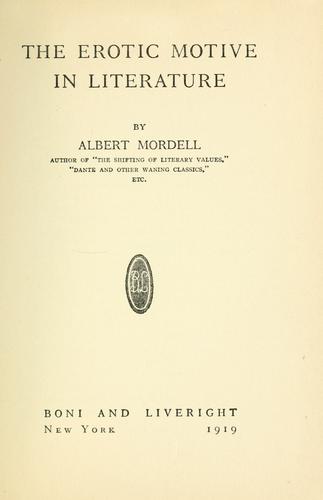
Erotic literature -- History and criticism; Psychoanalysis and literature; Sex in literature
The fact of one's being born in an earlier generation from the man
who propounds the new idea, is a large factor in the rejection of it.
Another unconscious reason for the repudiation of the new idea is that
it would cause us pain if it were true. We would also feel that we
had been dupes all our lives. We had been smugly following a pleasant
delusion that brought us some happiness and suddenly we see our bubble
pricked. We had been following a course of thinking and conduct,
that is now impeached by the new discovery. If a man has written
several books on miracles, original sin, and other dogmas, in which he
believes, and has spent all his life studying the subjects, he could
not accept a book which rejects his ideas; it would mean that he had
wasted his life. His aversion to concur with the conclusions of that
new book is nature's means of preventing him from suffering great pain;
it is a defence action. If a preacher has advised thousands of couples
who were unhappy not to divorce and not to remarry some one with
whom they might have been happy, he would be the last man to see the
greatness of a work that shows divorce may be a humane and beneficial
act in some cases, for it would mean that he would have to admit he has
ruined the lives of many people.
The real objection by man to the Copernican theory was that it
reflected on his religion and his vanity; it was annoying to hear that
the earth was not the centre of the universe. The Darwinian theory
was a still more painful discovery because it placed man among the
descendants of animals and taught that he was a by-product like them.
The facts, however, in both cases, were so overwhelming that many
managed to accept them and still keep their religious beliefs intact,
for these still give consolation. In spite of Copernicus and Darwin, we
still live as if the world were the centre of the universe and man its
most divine product.
The most personal and human argument in favour of a belief in personal
immortality of the soul, of communion with the dead or a Providential
Personal God, is that life would be sad if these theories were not
true; they must hence be true. Tennyson, in his _In Memoriam_, has the
popular attitude. If life didn't live for ever more, then "earth is
darkness at the core and dust and ashes all that is." But our wishes
must recede before logic and facts.
A great idea, then, is not accepted if its conclusions are painful to
us when a more pleasant idea has prevailed; every idea is rejected when
its possible truth would mean that we have been living in error and
wasting our lives. New ideas are nearly always made to fit in with the
old views.
The theory of evolution became acceptable only when it was demonstrated
to the satisfaction of the religionists what at first did not seem
apparent to them, that it interfered neither with a belief in a
personal God, Christianity nor the immortality of the soul.
Public-domain text, read in full here on John Shaqi.
Reviews
Reviews
No reviews yet
Be the first to share your thoughts on this work.
Elsewhere in the archive
Join the Discussion
Join the discussion
Sign in to leave a comment or review.
Sign InorCreate an account