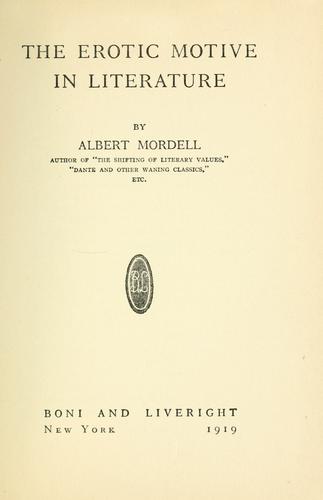
Erotic literature -- History and criticism; Psychoanalysis and literature; Sex in literature
Literary men who are advanced are admired often for qualities that
do not constitute their real greatness. The conservatives praise the
daring poet for his style, after he has made his way; or they select
a few of the minor ideas he champions and ignore the greater ones.
They will not accept the Hardy who wrote _Jude the Obscure_, but the
Hardy of _Far From the Maddening Crowd_; they will admire the early
harmless lyrics of John Davidson instead of the profound testaments
and later plays, whose real greatness was shown by Dr. Hayim Fineman
in his monograph on _John Davidson_.[G] They praise Swinburne for his
melody, Ibsen for his technique and Shaw for his wit, but can see no
intellectual value either in the _Songs Before Sunrise_, or _Peer
Gynt_, or _Man and Superman_. They overlook the value of Byron's _Don
Juan_ or _Cain_, because these works contain ideas that hurt most,
and instead they lavish compliments on harmless descriptions like the
address to the ocean, or the account of the battle of Waterloo. They
like Shelley's lyrics and see nothing in his ideas.
The "conspiracy of silence" that has often greeted many great men was
at times unconscious. People are not prone by nature to investigate
something which might bring painful results. They prefer to let it
alone altogether. The motive of ignoring a great book is founded on
one of displeasure. Hence morbid and pessimistic books, revolutionary
ideas, iconoclastic views on religion, morals or philosophy, new
discoveries in science, encounter opposition. We do not want to be
disturbed in our complacency. For the disturbance is, after all, made
by those who do not fit into the old order; their own discoveries are
defence processes. But gradually it is seen that these writers express
universal wants.
The opposition met by all investigations in the subject of sex, is an
example of man's effort to thrust painful things out of sight. The
barrier raised against Freud himself rises largely from three leading
ideas of his, those on the sexual significance of symbols in dreams and
the attributing of neurosis to sexual causes, and the theory that the
infant has a sexual life of its own. In spite of his broad use of the
term sexual and his many demonstrations of the truth of these ideas,
man does not want to believe them. Jung and Adler, who lay little
stress on the sexual element, have made the theory of psychoanalysis
acceptable to many; but Freud objects to the use of the word
psychoanalysis by disciples who have taken out of his theory something
he considers essential.
FOOTNOTE:
[G] Published by the University of Pennsylvania.
CHAPTER XIV
KEATS'S PERSONAL LOVE POEMS
I
Public-domain text, read in full here on John Shaqi.
Reviews
Reviews
No reviews yet
Be the first to share your thoughts on this work.
Elsewhere in the archive
Join the Discussion
Join the discussion
Sign in to leave a comment or review.
Sign InorCreate an account