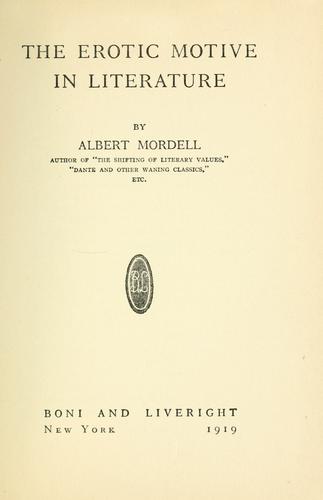
Erotic literature -- History and criticism; Psychoanalysis and literature; Sex in literature
We are now prepared to trace the origins of some of his work. Most
critics saw the unconscious allusions in the _La Belle Dame_ poem.
It is symbolic of himself in the snares of a coquette. There is an
allusion to an old song entitled _La Belle Dame Sans Merci_ in Keats's
_The Eve of St. Agnes_ which Porphyro played to Madeline while she
slept; it was a poem composed in Provence; and we all know that most
of the love poems of the Provençal Troubadours were complaints about
unrequited love. Keats's poem has a simple plot. A knight tells the
poet, in response to a question as to why he was so woe-begone, that
he met a fairy child and set her on his pacing steed. She claimed to
love him, and she lulled him to sleep and he dreamed that pale kings
and princes and warriors told him that he was in the thrall of a girl
without mercy. They were evidently also her victims. He wakes and
loiters on the cold hill side, realising that he was her victim.
This poem was written within a few months before the letter to Fanny
was penned, in which he said he resented having his heart made a
football. The poem corresponds to an anxiety dream. Freud tells us that
the contents of the anxiety dream is of a sexual nature; the libido has
been turned away from its object, and, not having succeeded in being
applied, has been transformed into fear. This poem is a good proof of
this one of the least-understood theories of Freud. Keats then is the
knight and Fanny is the fairy child.
The nature of his day dreams and jealousy appears in the _Ode to
Fanny_, a posthumous poem, probably not meant for publication. It
contains some of the substance of his letters to Fanny. He imagines he
is watching Fanny at a dance, and jealous thoughts come to him. "Who
now with greedy looks eats up my feast?" he asks. His only remedy is to
write poetry to ease his pain. He says to Physician Nature, "O, ease my
heart of verse and let me rest." He loves her so much he cannot bear
that any one profane her with looks. He wants her wholly, her thoughts
and emotions. The poem was probably written about the time of the
quarrel, in February, 1819.
Public-domain text, read in full here on John Shaqi.
Reviews
Reviews
No reviews yet
Be the first to share your thoughts on this work.
Elsewhere in the archive
Join the Discussion
Join the discussion
Sign in to leave a comment or review.
Sign InorCreate an account