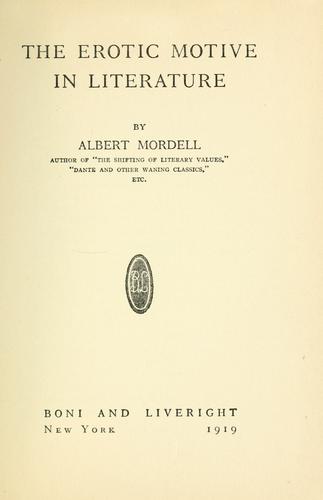
Erotic literature -- History and criticism; Psychoanalysis and literature; Sex in literature
His relations with women have been much criticised and also much
misunderstood. The first thing unusual about his life is the slight
influence his mother exerted upon him. Shelley, no doubt, loved
his mother, but he received very little sympathy from her. As a
result he became strongly attached to his sisters; in them he sought
unconsciously for the mother he had all but lost. He was alienated from
his father in boyhood, and there were definite clashes later. The poet
was the oldest of six children.
He loved his cousin, Harriet Grove, and was engaged to her. She broke
the engagement on account of the views he entertained. Her parents
influenced her in this action. It was Shelley's first love affair. The
poet was in his nineteenth year when he was jilted; he slept with a
loaded pistol and poison near him for some time after this. In January,
1811, in a letter to his friend, Hogg, he writes he would have followed
Harriet to the end of the earth. He asks his friend never to mention
her. He tells of a personal interview with Harriet and laments that
she is gone and that he still breathes and lives. On January 11 he
wrote: "She is gone! She is lost to me forever! She married! Married
to a clod of earth; she will become as insensible herself; all those
fine capabilities will moulder." She had, however, not yet married. It
was the recollections of these acute sufferings that he later put into
the mouth of the maniac in _Julian and Maddalo_; those poignant ravings
were for a half century regarded as impersonal, and were never thought
to be directed against a real woman whom he loved.
In the latter part of March, 1811, the poet was expelled from Oxford
for his pamphlet on atheism. In the meantime he had met Harriet
Westbrook and married her, in a spirit of gallantry, in the latter part
of August, 1811; he sympathised with her because of her sufferings at
home. He also liked Elizabeth Hitchener at the time, and later asked
her to come and live with his wife and himself. She did so about July,
1812. Shelley's wife had no liking for her, so Miss Hitchener was
practically bribed by the poet to leave. This she did in November.
Shelley was disillusioned in her, and he really had very little in
common with her, though she was intellectually superior to Harriet,
Shelley's wife.
In July, 1814, Shelley deserted his wife. A few weeks later he left
with Mary Godwin, with whom he had been friendly since the spring of
the year. On December, 1816, Harriet committed suicide by drowning,
while pregnant.
Shelley married his second wife legally December 30, 1816. He probably
was not madly in love with her. Mention should be made of two cases
of unreciprocated affection for him on the part of the poet's two
sisters-in-law, Fanny Godwin, who committed suicide, and Jane
Clairmont, the daughter of Mrs. Godwin by a previous marriage, and also
known as the mistress of Byron.
Public-domain text, read in full here on John Shaqi.
Reviews
Reviews
No reviews yet
Be the first to share your thoughts on this work.
Elsewhere in the archive
Join the Discussion
Join the discussion
Sign in to leave a comment or review.
Sign InorCreate an account