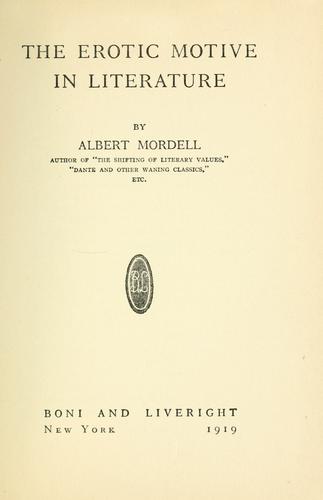
Erotic literature -- History and criticism; Psychoanalysis and literature; Sex in literature
The two women whom Shelley loved after his marriage and who inspired
some of his best poetry were Emilia Viviani and Mrs. James Williams.
Shelley met Miss Viviani about December, 1820. That winter he wrote
the _Epipsychidion_, which was a love poem to her; here he also told
us the history of his love affairs. In June, 1822, he refers to his
disillusionment with her. About this time his feeling for his friend's
wife, Mrs. Williams, overpowered him, and he wrote a number of lyrics
to her. He was drowned July 8, 1822, with Mr. Williams.
Shelley never had a satisfactory love affair in his life. He was
discarded by his first love, for whom his affection was strong. He
did not love his first wife at all, and his second wife did not give
him that satisfaction in love for which he craved. Hence he yearned
after others. His new affairs brought him no happiness, as he was
disillusioned in his Emilia, while Mrs. Williams was married to his
friend; social intercourse was for a while stopped between Shelley and
the Williamses on account of Shelley's love. Two other women who cared
for him did not attract him. This whole state of affairs led to some
of his best poems, brought out some of his views on free love, and
influenced his lyrics. We will examine how his poetry arose from the
depths of his unconscious.
_Julian and Maddalo_ was first sketched in 1814. The maniac's
soliloquy, which is one of the most forceful outcries of love
disappointment in poetry, inspired by personal experience, and is,
with Swinburne's _The Triumph of Time_, among the greatest of all such
products in literature, is Shelley's own outburst. It is his full
fury cast at Harriet Grove, and was not, as surmised by Arabella
Shore (_Gentleman's Magazine_ [1887], v. 263, p. 329). and H. S. Salt
(_Shelley Society Papers_ [1888], p. 325), directed against his first
wife. He never loved her as that maniac loved; besides, it was not
true of Harriet Westbrook that she ceased to love Shelley. It is said
that the poet believed her guilty of adultery while living with him,
but even if this were so (and we have no evidence to warrant such a
belief), the poet had been casting longing eyes at Mary Godwin, his
future second wife, for some time before he left his first wife; we
have no proof that the poet was heartbroken after he left Harriet
Westbrook, though he sympathised with her.
Public-domain text, read in full here on John Shaqi.
Reviews
Reviews
No reviews yet
Be the first to share your thoughts on this work.
Elsewhere in the archive
Join the Discussion
Join the discussion
Sign in to leave a comment or review.
Sign InorCreate an account