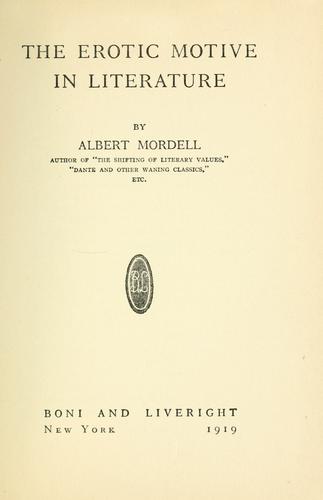
Erotic literature -- History and criticism; Psychoanalysis and literature; Sex in literature
Many of us are so constituted that we like to sit down with an author
like Montaigne or Hazlitt, who takes us into his confidence. We dislike
reticent and cold people in literature as much as in life. We do not
ask writers to tell us about their private affairs, but we want them to
talk at least indirectly about things that are close to their heart.
And one may be sure they will interest us. Shakespeare unlocked his
heart to us in his sonnets and in his plays as well.
It is of the world's great books that it can always be said as Whitman
did of his own, "Whoso touches this book touches a man."
II
Art and literature are realities in themselves. The depicting of an
event enshrines it as a thing of beauty; the event itself may be dull.
We meet Falstaffs in real life and waste no time on them; put into
a play by a master, Falstaff gives us an artistic thrill. How many
of the people who enjoy Dickens' novels about humble people would be
interested in them in real life? Dickens's magic pen makes us receive a
sensation reading about them that they cannot give us themselves. It is
the artist's personality and art that count.
Gissing and Flaubert wrote about ordinary people but they themselves
were intellectual aristocrats; they had nothing in common with the
people they wrote about (except with those who were disguised portraits
of themselves). In fact, they despised them; they personally were
recluses and merely sympathised with and were interested in the people
they wrote about as subjects for art. If we had met _Madame Bovary_
personally and heard her tale from her own mouth, the effect upon us
would be small compared to that of the novel.
The domestic troubles of our next door neighbours may be a bore to us.
We may not care to meet the people personally, but a great novel or
play describing the matrimonial difficulties of fictitious characters
gives us a distinct artistic thrill. The sorrows of people who lived
centuries ago move us more than those of people we know, because of the
magic power of art.
Those who from time immemorial called art magical were right. Many
people who disparage art and literature say to the writer and the
reader that they should enter the whirlpool of life, and live
themselves. No advice could be more foolhardy. To read beautiful
books about other people's lives is itself a high form of life, a life
that only art can furnish. It also has its advantages, when we think
of the characters in literature whom we enjoy reading about and yet
would never care to meet. Who would really want to meet Becky Sharp or
Pecksniff?
That artistic pleasure we get, mingled with actual pain on account of
the sorrows of poets, is to us a decided part of our lives. The fact
that we are brought into contact with a beautiful series of lines
voicing human grief in such a manner that both our human and æsthetic
emotions are aroused, is a privileged pleasure that only those who can
enjoy poetry may derive.
Public-domain text, read in full here on John Shaqi.
Reviews
Reviews
No reviews yet
Be the first to share your thoughts on this work.
Elsewhere in the archive
Join the Discussion
Join the discussion
Sign in to leave a comment or review.
Sign InorCreate an account