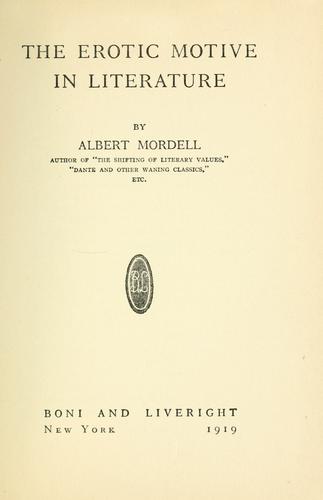
Erotic literature -- History and criticism; Psychoanalysis and literature; Sex in literature
Comes the question of the effect of psychoanalytic criticism upon our
judgment of living authors. Writers like George Moore, of the living,
and Strindberg, of the recently dead, have not waited for posterity
to make discoveries about their love affairs. They told us about them
frankly in their autobiographical works. Other writers, great poets
like Yeats and Symons, have sung of their loves more or less openly
in their lyrics. When posterity reads the biographies of these last
two poets, that will no doubt some day be written, it will, I believe,
learn that the emotions these poets expressed in their work had a real
basis. But we have no right to probe into an author's private life
while he is alive; we may make detailed deductions from his work, but
we should not give them publicity. The reader who finds the early
Kipling cynical about women, who notes Hardy constantly reiterating
the tragedies caused by love, may venture to guess there must be some
reason for this, but it would be a vicious criticism that made this
topic the subject of an article while these men are alive. One who
reads Wells' _New Machiavelli_ or Dreiser's _The Genius_ and observes
the author's preoccupation with the marriage problem, may also draw his
own conclusions about how much the fiction is inspired by reality, but
it is a fitter subject for posterity to take up. Occasionally an author
like Robert Herrick or Upton Sinclair has his domestic affairs dragged
into the limelight, on account of the sensational interest of our
newspapers, and the reader learns that novels like _One Woman's Life_
and _Love's Pilgrimage_ were somewhat autobiographical.
There has been a great tendency in our day on the part of authors to
write autobiographical novels. We should not deprecate this tendency.
When I think that Balzac, Stendhal, Flaubert and Zola, Tolstoi,
Dostoievsky and Turgenev, Scott, Dickens, Thackeray, George Eliot,
George Meredith and Henry James were often autobiographical, I realise
that all literary men, novelists as well as poets, are compelled
to wear their hearts on their sleeves by virtue of their art. That
criticism which reproached Rousseau, Chateaubriand, Senancour and De
Musset for having been occupied too much with themselves is unfair.
With whom else would the critics have the authors occupied? A man
cannot get out of himself. When he undertakes to write a book, he tells
us practically beforehand that he is going to talk about himself.
Therefore, such excellent novels of our time as Jack London's _Martin
Eden_, Stephen French Whitman's _Predestined_, Maugham's _Of Human
Bondage_ and Beresford's _Invisible Event_ are to be commended. Should
these authors' renown live, posterity will learn that some of the
emotional life lived by the characters had been experienced by the
authors themselves. It is, however, not a matter of importance whether
the mere incidents recorded in these novels actually transpired in the
authors' lives.
Public-domain text, read in full here on John Shaqi.
Reviews
Reviews
No reviews yet
Be the first to share your thoughts on this work.
Elsewhere in the archive
Join the Discussion
Join the discussion
Sign in to leave a comment or review.
Sign InorCreate an account