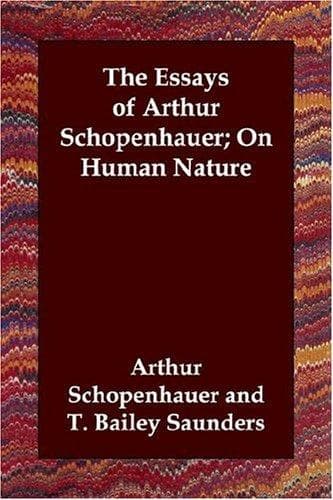
The Essays of Arthur Schopenhauer; On Human NatureSchopenhauer, Arthur
Philosophy
The Essays of Arthur Schopenhauer; On Human Nature
Schopenhauer, Arthur
Ethics; Political science
The readers of my _Ethics_ know that with me the ultimate foundation
of morality is the truth which in the _Vedas_ and the _Vedanta_
receives its expression in the established, mystical formula, _Tat
twam asi (This is thyself_), which is spoken with reference to every
living thing, be it man or beast, and is called the _Mahavakya_, the
great word.
Actions which proceed in accordance with this principle, such as those
of the philanthropist, may indeed be regarded as the beginning of
mysticism. Every benefit rendered with a pure intention proclaims that
the man who exercises it acts in direct conflict with the world of
appearance; for he recognises himself as identical with another
individual, who exists in complete separation from him. Accordingly,
all disinterested kindness is inexplicable; it is a mystery; and hence
in order to explain it a man has to resort to all sorts of fictions.
When Kant had demolished all other arguments for theism, he admitted
one only, that it gave the best interpretation and solution of such
mysterious actions, and of all others like them. He therefore allowed
it to stand as a presumption unsusceptible indeed of theoretical
proof, but valid from a practical point of view. I may, however,
express my doubts whether he was quite serious about it. For to make
morality rest on theism is really to reduce morality to egoism;
although the English, it is true, as also the lowest classes of
society with us, do not perceive the possibility of any other
foundation for it.
Public-domain text, read in full here on John Shaqi.
Reviews
Reviews
No reviews yet
Be the first to share your thoughts on this work.
Join the Discussion
Join the discussion
Sign in to leave a comment or review.
Sign InorCreate an account