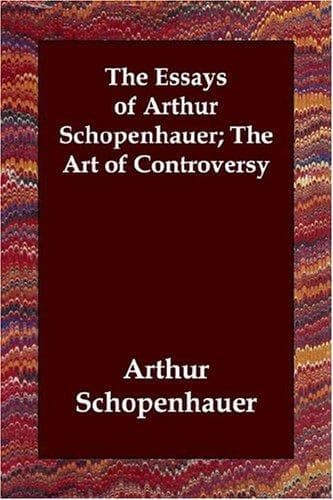
The Essays of Arthur Schopenhauer; the Art of ControversySchopenhauer, Arthur
Philosophy
The Essays of Arthur Schopenhauer; the Art of Controversy
Schopenhauer, Arthur
Debates and debating; Logic
Such is the framework or skeleton of all forms of disputation; for to
this every kind of controversy may be ultimately reduced. The whole of
a controversy may, however, actually proceed in the manner described,
or only appear to do so; and it may be supported by genuine or
spurious arguments. It is just because it is not easy to make out
the truth in regard to this matter, that debates are so long and so
obstinate.
Nor can we, in ordering the argument, separate actual from apparent
truth, since even the disputants are not certain about it beforehand.
Therefore I shall describe the various tricks or stratagems without
regard to questions of objective truth or falsity; for that is a
matter on which we have no assurance, and which cannot be determined
previously. Moreover, in every disputation or argument on any subject
we must agree about something; and by this, as a principle, we must be
willing to judge the matter in question. We cannot argue with those
who deny principles: _Contra negantem principia non est disputandum_.
STRATAGEMS.
I.
The _Extension_.--This consists in carrying your opponent's
proposition beyond its natural limits; in giving it as general a
signification and as wide a sense as possible, so as to exaggerate it;
and, on the other hand, in giving your own proposition as restricted
a sense and as narrow limits as you can, because the more general a
statement becomes, the more numerous are the objections to which it is
open. The defence consists in an accurate statement of the point or
essential question at issue.
Example 1.--I asserted that the English were supreme in drama. My
opponent attempted _to_ give an instance to the contrary, and replied
that it was a well-known fact that in music, and consequently in
opera, they could do nothing at all. I repelled the attack by
reminding him that music was not included in dramatic art, which
covered tragedy and comedy alone. This he knew very well. What he had
done was to try to generalise my proposition, so that it would apply
to all theatrical representations, and, consequently, to opera and
then to music, in order to make certain of defeating me. Contrarily,
we may save our proposition by reducing it within narrower limits
than we had first intended, if our way of expressing it favours this
expedient.
Example 2.--A. declares that the Peace of 1814 gave back their
independence to all the German towns of the Hanseatic League. B. gives
an instance to the contrary by reciting the fact that Dantzig, which
received its independence from Buonaparte, lost it by that Peace. A.
saves himself thus: "I said 'all German towns,' and Dantzig was in
Poland."
This trick was mentioned by Aristotle in the _Topica_ (bk. viii., cc.
11, 12).
Public-domain text, read in full here on John Shaqi.
Reviews
Reviews
No reviews yet
Be the first to share your thoughts on this work.
Join the Discussion
Join the discussion
Sign in to leave a comment or review.
Sign InorCreate an account