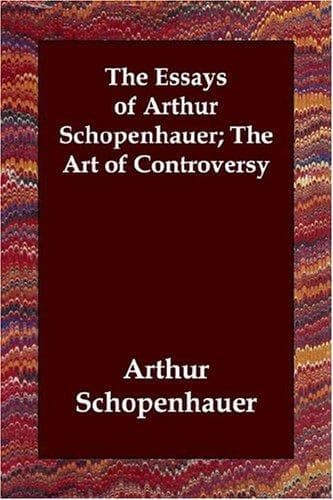
The Essays of Arthur Schopenhauer; the Art of ControversySchopenhauer, Arthur
Philosophy
The Essays of Arthur Schopenhauer; the Art of Controversy
Schopenhauer, Arthur
Debates and debating; Logic
To prove the truth of a proposition, you may also employ previous
propositions that are not true, should your opponent refuse to admit
the true ones, either because he fails to perceive their truth, or
because he sees that the thesis immediately follows from them. In that
case the plan is to take propositions which are false in themselves
but true for your opponent, and argue from the way in which he thinks,
that is to say, _ex concessis_. For a true conclusion may follow
from false premisses, but not _vice versâ_. In the same fashion
your opponent's false propositions may be refuted by other false
propositions, which he, however, takes to be true; for it is with him
that you have to do, and you must use the thoughts that he uses. For
instance, if he is a member of some sect to which you do not belong,
you may employ the declared, opinions of this sect against him, as
principles.[1]
[Footnote 1: Aristotle, _Topica_ bk. viii., chap. 2.]
VI.
Another plan is to beg the question in disguise by postulating what
has to be proved, either (1) under another name; for instance, "good
repute" instead of "honour"; "virtue" instead of "virginity," etc.;
or by using such convertible terms as "red-blooded animals" and
"vertebrates"; or (2) by making a general assumption covering the
particular point in dispute; for instance, maintaining the uncertainty
of medicine by postulating the uncertainty of all human knowledge. (3)
If, _vice versâ_, two things follow one from the other, and one is to
be proved, you may postulate the other. (4) If a general proposition
is to be proved, you may get your opponent to admit every one of the
particulars. This is the converse of the second.[1]
[Footnote 1: _Idem_, chap. 11. The last chapter of this work contains
some good rules for the practice of Dialectics.]
VII.
Should the disputation be conducted on somewhat strict and formal
lines, and there be a desire to arrive at a very clear understanding,
he who states the proposition and wants to prove it may proceed
against his opponent by question, in order to show the truth of the
statement from his admissions. The erotematic, or Socratic, method was
especially in use among the ancients; and this and some of the tricks
following later on are akin to it.[1]
[Footnote 1: They are all a free version of chap. 15 of Aristotle's
_De Sophistici Elenchis_.]
The plan is to ask a great many wide-reaching questions at once, so as
to hide what you want to get admitted, and, on the other hand, quickly
propound the argument resulting from the admissions; for those who are
slow of understanding cannot follow accurately, and do not notice any
mistakes or gaps there may be in the demonstration.
VIII.
This trick consists in making your opponent angry; for when he is
angry he is incapable of judging aright, and perceiving where
his advantage lies. You can make him angry by doing him repeated
injustice, or practising some kind of chicanery, and being generally
insolent.
IX.
Public-domain text, read in full here on John Shaqi.
Reviews
Reviews
No reviews yet
Be the first to share your thoughts on this work.
Join the Discussion
Join the discussion
Sign in to leave a comment or review.
Sign InorCreate an account