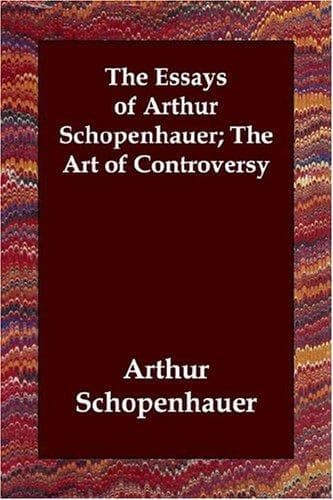
The Essays of Arthur Schopenhauer; the Art of ControversySchopenhauer, Arthur
Philosophy
The Essays of Arthur Schopenhauer; the Art of Controversy
Schopenhauer, Arthur
Debates and debating; Logic
It is a pity that the words have thus been used from of old, and that
I am not quite at liberty to distinguish their meanings. Otherwise, I
should have preferred to define _Logic_ (from [Greek: logos], "word"
and "reason," which are inseparable) as "the science of the laws of
thought, that is, of the method of reason"; and _Dialectic_ (from
[Greek: dialegesthai], "to converse"--and every conversation
communicates either facts or opinions, that is to say, it is
historical or deliberative) as "the art of disputation," in the modern
sense of the word. It it clear, then, that Logic deals with a subject
of a purely _à priori_ character, separable in definition from
experience, namely, the laws of thought, the process of reason or the
[Greek: logos], the laws, that is, which reason follows when it is
left to itself and not hindered, as in the case of solitary thought on
the part of a rational being who is in no way misled. Dialectic, on
the other hand, would treat of the intercourse between two rational
beings who, because they are rational, ought to think in common, but
who, as soon as they cease to agree like two clocks keeping exactly
the same time, create a disputation, or intellectual contest. Regarded
as purely rational beings, the individuals would, I say, necessarily
be in agreement, and their variation springs from the difference
essential to individuality; in other words, it is drawn from
experience.
Logic, therefore, as the science of thought, or the science of the
process of pure reason, should be capable of being constructed _à
priori_. Dialectic, for the most part, can be constructed only _à
posteriori_; that is to say, we may learn its rules by an experiential
knowledge of the disturbance which pure thought suffers through the
difference of individuality manifested in the intercourse between
two rational beings, and also by acquaintance with the means which
disputants adopt in order to make good against one another their own
individual thought, and to show that it is pure and objective. For
human nature is such that if A. and B. are engaged in thinking in
common, and are communicating their opinions to one another on any
subject, so long as it is not a mere fact of history, and A. perceives
that B.'s thoughts on one and the same subject are not the same as his
own, he does not begin by revising his own process of thinking, so as
to discover any mistake which he may have made, but he assumes that
the mistake has occurred in B.'s. In other words, man is naturally
obstinate; and this quality in him is attended with certain results,
treated of in the branch of knowledge which I should like to call
Dialectic, but which, in order to avoid misunderstanding, I shall call
Controversial or Eristical Dialectic. Accordingly, it is the branch
of knowledge which treats of the obstinacy natural to man. Eristic is
only a harsher name for the same thing.
Public-domain text, read in full here on John Shaqi.
Reviews
Reviews
No reviews yet
Be the first to share your thoughts on this work.
Join the Discussion
Join the discussion
Sign in to leave a comment or review.
Sign InorCreate an account