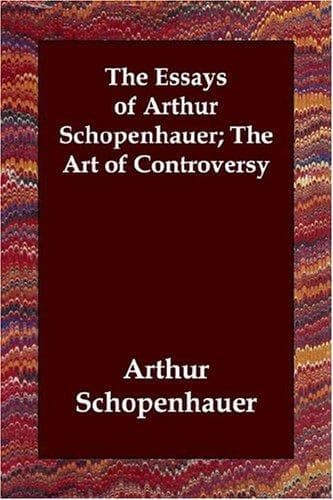
The Essays of Arthur Schopenhauer; the Art of ControversySchopenhauer, Arthur
Philosophy
The Essays of Arthur Schopenhauer; the Art of Controversy
Schopenhauer, Arthur
Debates and debating; Logic
[Footnote 1: Machiavelli recommends his Prince to make use of every
moment that his neighbour is weak, in order to attack him; as
otherwise his neighbour may do the same. If honour and fidelity
prevailed in the world, it would be a different matter; but as these
are qualities not to be expected, a man must not practise them
himself, because he will meet with a bad return. It is just the same
in a dispute: if I allow that my opponent is right as soon as he seems
to be so, it is scarcely probable that he will do the same when the
position is reversed; and as he acts wrongly, I am compelled to act
wrongly too. It is easy to say that we must yield to truth, without
any prepossession in favour of our own statements; but we cannot
assume that our opponent will do it, and therefore we cannot do
it either. Nay, if I were to abandon the position on which I had
previously bestowed much thought, as soon as it appeared that he was
right, it might easily happen that I might be misled by a momentary
impression, and give up the truth in order to accept an error.]
To some extent every man is armed against such a procedure by his own
cunning and villainy. He learns by daily experience, and thus comes
to have his own _natural Dialectic_, just as he has his own _natural
Logic_. But his Dialectic is by no means as safe a guide as his Logic.
It is not so easy for any one to think or draw an inference contrary
to the laws of Logic; false judgments are frequent, false conclusions
very rare. A man cannot easily be deficient in natural Logic, but he
may very easily be deficient in natural Dialectic, which is a gift
apportioned in unequal measure. In so far natural Dialectic resembles
the faculty of judgment, which differs in degree with every man; while
reason, strictly speaking, is the same. For it often happens that in
a matter in which a man is really in the right, he is confounded or
refuted by merely superficial arguments; and if he emerges victorious
from a contest, he owes it very often not so much to the correctness
of his judgment in stating his proposition, as to the cunning and
address with which he defended it.
Here, as in all other cases, the best gifts are born with a man;
nevertheless, much may be done to make him a master of this art by
practice, and also by a consideration of the tactics which may be used
to defeat an opponent, or which he uses himself for a similar purpose.
Therefore, even though Logic may be of no very real, practical use,
Dialectic may certainly be so; and Aristotle, too, seems to me to
have drawn up his Logic proper, or Analytic, as a foundation and
preparation for his Dialectic, and to have made this his chief
business. Logic is concerned with the mere form of propositions;
Dialectic, with their contents or matter--in a word, with their
substance. It was proper, therefore, to consider the general form of
all propositions before proceeding to particulars.
Public-domain text, read in full here on John Shaqi.
Reviews
Reviews
No reviews yet
Be the first to share your thoughts on this work.
Join the Discussion
Join the discussion
Sign in to leave a comment or review.
Sign InorCreate an account