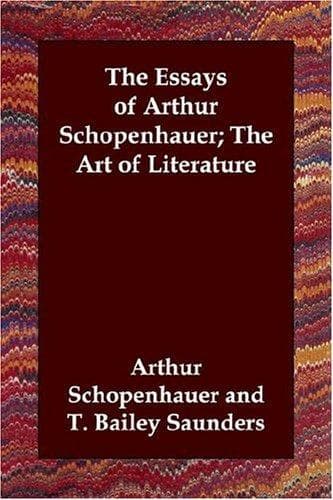
The Essays of Arthur Schopenhauer; The Art of Literature — John Shaqi
The Essays of Arthur Schopenhauer; The Art of LiteratureSchopenhauer, Arthur
Philosophy
The Essays of Arthur Schopenhauer; The Art of Literature
Schopenhauer, Arthur
Literature -- Philosophy
_Dilettanti, dilettanti!_ This is the slighting way in which those who
pursue any branch of art or learning for the love and enjoyment of the
thing,--_per il loro diletto_, are spoken of by those who have taken
it up for the sake of gain, attracted solely by the prospect of money.
This contempt of theirs comes from the base belief that no man will
seriously devote himself to a subject, unless he is spurred on to it
by want, hunger, or else some form of greed. The public is of the same
way of thinking; and hence its general respect for professionals and
its distrust of _dilettanti_. But the truth is that the _dilettante_
treats his subject as an end, whereas the professional, pure and
simple, treats it merely as a means. He alone will be really in
earnest about a matter, who has a direct interest therein, takes to it
because he likes it, and pursues it _con amore_. It is these, and not
hirelings, that have always done the greatest work.
In the republic of letters it is as in other republics; favor is shown
to the plain man--he who goes his way in silence and does not set up
to be cleverer than others. But the abnormal man is looked upon as
threatening danger; people band together against him, and have, oh!
such a majority on their side.
The condition of this republic is much like that of a small State in
America, where every man is intent only upon his own advantage, and
seeks reputation and power for himself, quite heedless of the general
weal, which then goes to ruin. So it is in the republic of letters;
it is himself, and himself alone, that a man puts forward, because he
wants to gain fame. The only thing in which all agree is in trying to
keep down a really eminent man, if he should chance to show himself,
as one who would be a common peril. From this it is easy to see how it
fares with knowledge as a whole.
Between professors and independent men of learning there has always
been from of old a certain antagonism, which may perhaps be likened
to that existing been dogs and wolves. In virtue of their position,
professors enjoy great facilities for becoming known to their
contemporaries. Contrarily, independent men of learning enjoy, by
their position, great facilities for becoming known to posterity; to
which it is necessary that, amongst other and much rarer gifts, a man
should have a certain leisure and freedom. As mankind takes a long
time in finding out on whom to bestow its attention, they may both
work together side by side.
He who holds a professorship may be said to receive his food in the
stall; and this is the best way with ruminant animals. But he who
finds his food for himself at the hands of Nature is better off in the
open field.
Public-domain text, read in full here on John Shaqi.
Reviews
Reviews
No reviews yet
Be the first to share your thoughts on this work.
Join the Discussion
Join the discussion
Sign in to leave a comment or review.
Sign InorCreate an account