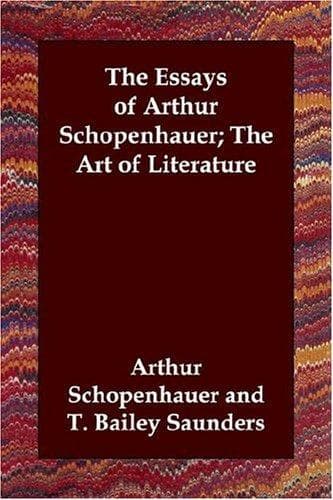
The Essays of Arthur Schopenhauer; The Art of LiteratureSchopenhauer, Arthur
Philosophy
The Essays of Arthur Schopenhauer; The Art of Literature
Schopenhauer, Arthur
Literature -- Philosophy
After these considerations, it will not be matter for surprise that
a man who thinks for himself can easily be distinguished from the
book-philosopher by the very way in which he talks, by his marked
earnestness, and the originality, directness, and personal conviction
that stamp all his thoughts and expressions. The book-philosopher, on
the other hand, lets it be seen that everything he has is second-hand;
that his ideas are like the number and trash of an old furniture-shop,
collected together from all quarters. Mentally, he is dull and
pointless--a copy of a copy. His literary style is made up of
conventional, nay, vulgar phrases, and terms that happen to be
current; in this respect much like a small State where all the money
that circulates is foreign, because it has no coinage of its own.
Mere experience can as little as reading supply the place of thought.
It stands to thinking in the same relation in which eating stands
to digestion and assimilation. When experience boasts that to its
discoveries alone is due the advancement of the human race, it is as
though the mouth were to claim the whole credit of maintaining the
body in health.
The works of all truly capable minds are distinguished by a character
of _decision_ and _definiteness_, which means they are clear and free
from obscurity. A truly capable mind always knows definitely and
clearly what it is that it wants to express, whether its medium is
prose, verse, or music. Other minds are not decisive and not definite;
and by this they may be known for what they are.
The characteristic sign of a mind of the highest order is that it
always judges at first hand. Everything it advances is the result of
thinking for itself; and this is everywhere evident by the way in
which it gives its thoughts utterance. Such a mind is like a Prince.
In the realm of intellect its authority is imperial, whereas the
authority of minds of a lower order is delegated only; as may be seen
in their style, which has no independent stamp of its own.
Every one who really thinks for himself is so far like a monarch.
His position is undelegated and supreme. His judgments, like royal
decrees, spring from his own sovereign power and proceed directly from
himself. He acknowledges authority as little as a monarch admits a
command; he subscribes to nothing but what he has himself authorized.
The multitude of common minds, laboring under all sorts of current
opinions, authorities, prejudices, is like the people, which silently
obeys the law and accepts orders from above.
Public-domain text, read in full here on John Shaqi.
Reviews
Reviews
No reviews yet
Be the first to share your thoughts on this work.
Join the Discussion
Join the discussion
Sign in to leave a comment or review.
Sign InorCreate an account