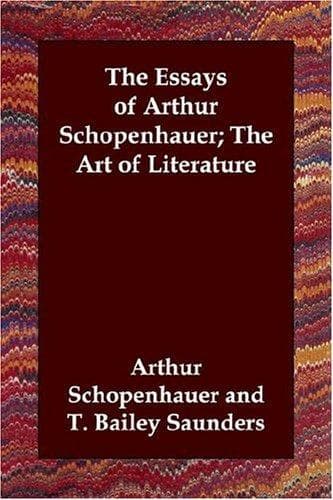
The Essays of Arthur Schopenhauer; The Art of Literature — John Shaqi
The Essays of Arthur Schopenhauer; The Art of LiteratureSchopenhauer, Arthur
Philosophy
The Essays of Arthur Schopenhauer; The Art of Literature
Schopenhauer, Arthur
Literature -- Philosophy
It was probably to meet a real want that, a year or two ago, an
ingenious person succeeded in drawing a great number of English and
American writers into a confession of their literary creed and the art
they adopted in authorship; and the interesting volume in which he
gave these confessions to the world contained some very good advice,
although most of it had been said before in different forms. More
recently a new departure, of very doubtful use, has taken place; and
two books have been issued, which aim, the one at being an author's
manual, the other at giving hints on essays and how to write them.
A glance at these books will probably show that their authors have
still something to learn.
Both of these ventures seem, unhappily, to be popular; and, although
they may claim a position next-door to that of the present volume I
beg to say that it has no connection with them whatever. Schopenhauer
does not attempt to teach the art of making bricks without straw.
I wish to take this opportunity of tendering my thanks to a large
number of reviewers for the very gratifying reception given to
the earlier volumes of this series. And I have great pleasure in
expressing my obligations to my friend Mr. W.G. Collingwood, who has
looked over most of my proofs and often given me excellent advice in
my effort to turn Schopenhauer into readable English.
T.B.S.
ON AUTHORSHIP.
There are, first of all, two kinds of authors: those who write for the
subject's sake, and those who write for writing's sake. While the
one have had thoughts or experiences which seem to them worth
communicating, the others want money; and so they write, for money.
Their thinking is part of the business of writing. They may be
recognized by the way in which they spin out their thoughts to the
greatest possible length; then, too, by the very nature of their
thoughts, which are only half-true, perverse, forced, vacillating;
again, by the aversion they generally show to saying anything straight
out, so that they may seem other than they are. Hence their writing
is deficient in clearness and definiteness, and it is not long before
they betray that their only object in writing at all is to cover
paper. This sometimes happens with the best authors; now and then, for
example, with Lessing in his _Dramaturgie_, and even in many of Jean
Paul's romances. As soon as the reader perceives this, let him throw
the book away; for time is precious. The truth is that when an author
begins to write for the sake of covering paper, he is cheating the
reader; because he writes under the pretext that he has something to
say.
Public-domain text, read in full here on John Shaqi.
Reviews
Reviews
No reviews yet
Be the first to share your thoughts on this work.
Join the Discussion
Join the discussion
Sign in to leave a comment or review.
Sign InorCreate an account