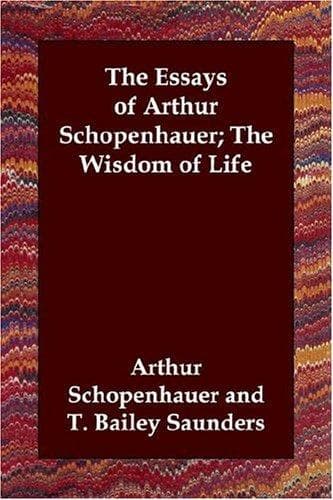
The Essays of Arthur Schopenhauer: the Wisdom of Life — John Shaqi
The Essays of Arthur Schopenhauer: the Wisdom of LifeSchopenhauer, Arthur
Philosophy
The Essays of Arthur Schopenhauer: the Wisdom of Life
Schopenhauer, Arthur
Conduct of life; Maxims
the wealth of the soul is the only true wealth, for with all other
riches comes a bane even greater than they. The man of inner wealth
wants nothing from outside but the negative gift of undisturbed
leisure, to develop and mature his intellectual faculties, that is,
to enjoy his wealth; in short, he wants permission to be himself,
his whole life long, every day and every hour. If he is destined to
impress the character of his mind upon a whole race, he has only one
measure of happiness or unhappiness--to succeed or fail in perfecting
his powers and completing his work. All else is of small consequence.
Accordingly, the greatest minds of all ages have set the highest value
upon undisturbed leisure, as worth exactly as much as the man himself.
_Happiness appears to consist in leisure_, says Aristotle;[1] and
Diogenes Laertius reports that _Socrates praised leisure as the
fairest of all possessions_. So, in the _Nichomachean Ethics_,
Aristotle concludes that a life devoted to philosophy is the happiest;
or, as he says in the _Politics,[2] the free exercise of any power,
whatever it may be, is happiness_. This again, tallies with what
Goethe says in _Wilhelm Meister: The man who is born with a talent
which he is meant to use, finds his greatest happiness in using it_.
[Footnote 1: Eth. Nichom. x. 7.]
[Footnote 2: iv. 11.]
But to be in possession of undisturbed leisure, is far from being
the common lot; nay, it is something alien to human nature, for the
ordinary man's destiny is to spend life in procuring what is necessary
for the subsistence of himself and his family; he is a son of struggle
and need, not a free intelligence. So people as a rule soon get tired
of undisturbed leisure, and it becomes burdensome if there are no
fictitious and forced aims to occupy it, play, pastime and hobbies of
every kind. For this very reason it is full of possible danger, and
_difficilis in otio quies_ is a true saying,--it is difficult to keep
quiet if you have nothing to do. On the other hand, a measure of
intellect far surpassing the ordinary, is as unnatural as it is
abnormal. But if it exists, and the man endowed with it is to be
happy, he will want precisely that undisturbed leisure which the
others find burdensome or pernicious; for without it he is a Pegasus
in harness, and consequently unhappy. If these two unnatural
circumstances, external, and internal, undisturbed leisure and great
intellect, happen to coincide in the same person, it is a great piece
of fortune; and if the fate is so far favorable, a man can lead the
higher life, the life protected from the two opposite sources of human
suffering, pain and boredom, from the painful struggle for existence,
and the incapacity for enduring leisure (which is free existence
itself)--evils which may be escaped only by being mutually
neutralized.
Public-domain text, read in full here on John Shaqi.
Reviews
Reviews
No reviews yet
Be the first to share your thoughts on this work.
Join the Discussion
Join the discussion
Sign in to leave a comment or review.
Sign InorCreate an account