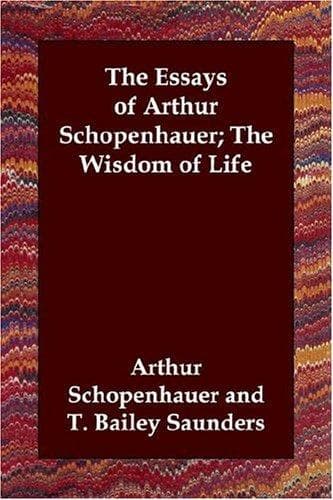
The Essays of Arthur Schopenhauer: the Wisdom of LifeSchopenhauer, Arthur
Philosophy
The Essays of Arthur Schopenhauer: the Wisdom of Life
Schopenhauer, Arthur
Conduct of life; Maxims
I do not by any means think that I am touching upon a subject which is
not worth my while to mention when I recommend people to be careful to
preserve what they have earned or inherited. For to start life with
just as much as will make one independent, that is, allow one to live
comfortably without having to work--even if one has only just enough
for oneself, not to speak of a family--is an advantage which cannot be
over-estimated; for it means exemption and immunity from that chronic
disease of penury, which fastens on the life of man like a plague; it
is emancipation from that forced labor which is the natural lot of
every mortal. Only under a favorable fate like this can a man be said
to be born free, to be, in the proper sense of the word, _sui juris_,
master of his own time and powers, and able to say every morning,
_This day is my own_. And just for the same reason the difference
between the man who has a hundred a year and the man who has a
thousand, is infinitely smaller than the difference between the former
and a man who has nothing at all. But inherited wealth reaches its
utmost value when it falls to the individual endowed with mental
powers of a high order, who is resolved to pursue a line of life not
compatible with the making of money; for he is then doubly endowed by
fate and can live for his genius; and he will pay his debt to mankind
a hundred times, by achieving what no other could achieve, by
producing some work which contributes to the general good, and
redounds to the honor of humanity at large. Another, again, may
use his wealth to further philanthropic schemes, and make himself
well-deserving of his fellowmen. But a man who does none of these
things, who does not even try to do them, who never attempts to learn
the rudiments of any branch of knowledge so that he may at least do
what he can towards promoting it--such a one, born as he is into
riches, is a mere idler and thief of time, a contemptible fellow. He
will not even be happy, because, in his case, exemption from need
delivers him up to the other extreme of human suffering, boredom,
which is such martyrdom to him, that he would have been better off if
poverty had given him something to do. And as he is bored he is apt to
be extravagant, and so lose the advantage of which he showed himself
unworthy. Countless numbers of people find themselves in want, simply
because, when they had money, they spent it only to get momentary
relief from the feeling of boredom which oppressed them.
Public-domain text, read in full here on John Shaqi.
Reviews
Reviews
No reviews yet
Be the first to share your thoughts on this work.
Join the Discussion
Join the discussion
Sign in to leave a comment or review.
Sign InorCreate an account